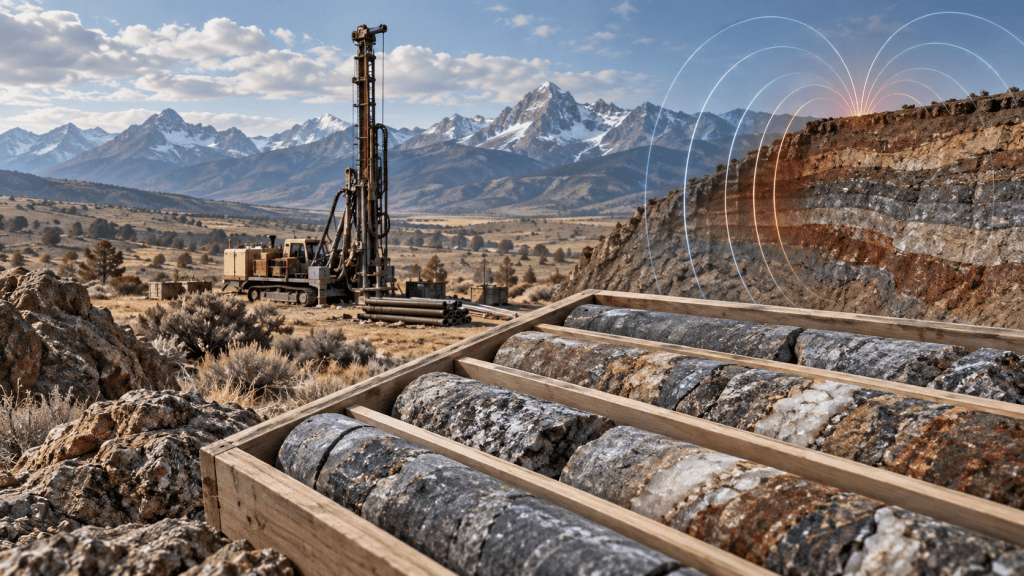
Summary: Certified results from the first six holes in a 2026 feasibility drilling program at Wyoming’s Cowboy State Mine area add new technical data to a project intended to supply rare earth oxides, including magnet-related feedstock. The results support continued feasibility work, but they do not establish a mineral reserve, mine approval, production schedule, or qualified magnet supply.
Initial feasibility drilling confirms broad mineralized intervals
American Rare Earths reported certified laboratory results for the first six of 18 planned HQ core holes at the Cowboy State Mine area of the Halleck Creek project in Wyoming. The company said the dataset covers 386 unique geological assay intervals after quality-control samples were excluded from the exploration statistics.
Across those intervals, the reported pooled average was 3,497 parts per million total rare earth oxides (TREO), with a median of 3,879 ppm. The company also reported that 358 of the 386 intervals exceeded its 1,000 ppm TREO resource cut-off grade. One hole included 191 metres of continuous mineralization under the company’s stated compositing method.
These figures are useful inputs for geological modeling because they describe grade distribution and continuity across the first part of the program. They should not be read as a direct forecast of recoverable product, operating cost, or magnet output. True widths were not known for the reported downhole intervals, and results from the remaining 12 holes were still pending at the time of the announcement.
Why the results matter to the magnet supply chain
The announcement separates total rare earth oxide data from magnet rare earth oxide data. It defines magnet rare earth oxides as the reported oxides of praseodymium, neodymium, samarium, terbium, and dysprosium. These elements are relevant to permanent-magnet supply chains, but ore-grade information is only the start of a much longer qualification path.
For magnet manufacturers and industrial buyers, a credible upstream project must move through resource definition, metallurgy, recovery testing, feasibility engineering, permitting, financing, construction, commissioning, and product qualification. The drilling update adds evidence at the geological stage. It does not yet answer questions about concentrate quality, separated-oxide recovery, impurity control, commercial timing, or material consistency.
What procurement teams should monitor next
- Remaining assays: Results from the other 12 planned holes may change the geological interpretation or resource-conversion picture.
- Metallurgical performance: Recovery rates, reagent use, impurity removal, and final product specifications will matter more to downstream qualification than head grade alone.
- Feasibility assumptions: Future technical studies should clarify mine design, processing flowsheets, capital requirements, operating costs, and development timing.
- Magnet-grade pathway: Buyers should look for evidence connecting any future oxide product to separation, metal and alloy production, and qualified NdFeB magnet capacity.
The update is therefore best treated as a project-development signal rather than an immediate supply event. It adds independently certified assay data to the feasibility process while leaving the commercial and manufacturing questions open.
Source: GlobeNewswire — American Rare Earths Reports Strong Initial Assay Results from 2026 Feasibility Drilling at Halleck Creek (published September 21, 2026, 11:28 ET).