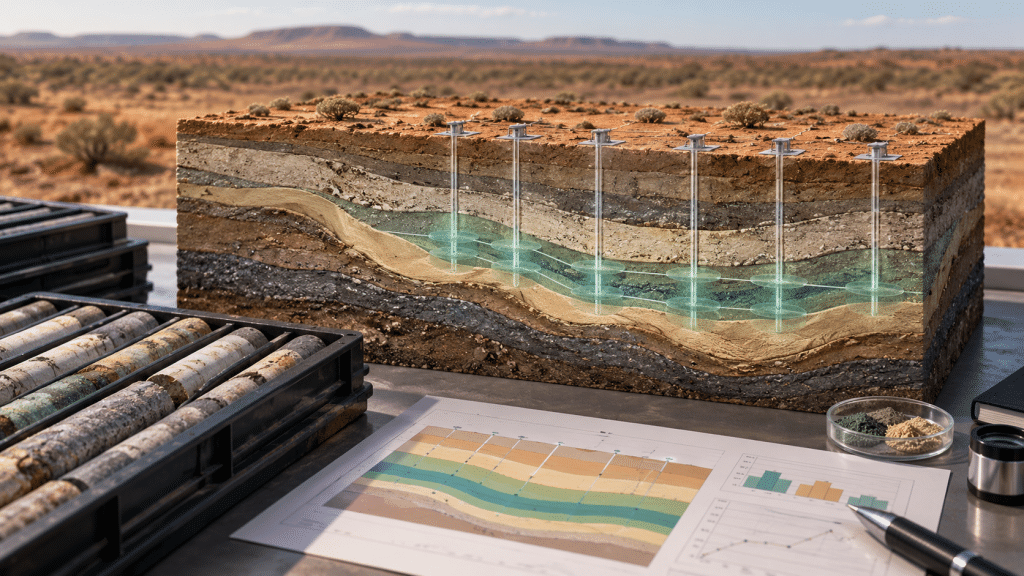
Summary: Cobra Resources has reported a maiden mineral resource of 150 million metric tons at 470 ppm total rare-earth oxides for the Wudinna project in South Australia. The estimate gives the planned scoping study a larger technical base, but it is not an ore reserve and does not establish future production or saleable magnet materials.
A first resource model for Wudinna
Cobra Resources released Wudinna’s first JORC-compliant mineral resource estimate on October 26. The model contains 150 million metric tons at an average grade of 470 ppm total rare-earth oxides, equivalent to an estimated 70,400 metric tons of contained TREO. The company classified 60 million metric tons at 572 ppm TREO as Indicated, with the balance in the Inferred category.
The reported basket includes neodymium-praseodymium and dysprosium-terbium oxides, which are relevant to high-performance permanent magnets. The combined model averages 101 ppm Nd-Pr oxides and 10 ppm Dy-Tb oxides. Those in-ground concentrations are not the same as recoverable separated oxides, metals, alloys or finished magnets.
Two potential extraction routes are still being assessed
The resource covers mineralization in the Pidinga and Garford formations. Cobra is assessing controlled in-situ recovery for permeable palaeochannel material and open-cut mining with heap leaching for less permeable areas. The company reported that 61% of the Pidinga tonnes and 57% of its contained TREO metal have been evaluated as amenable to in-situ recovery.
In-situ recovery would use injection and extraction wells to mobilize adsorbed rare-earth ions without conventional bulk excavation. However, the announcement also says that further work is needed to demonstrate permeability and recovery for additional material. Hydrology, reagent consumption, impurity behavior, environmental controls and solution processing will be central to the next technical stage.
What downstream buyers should watch
- Recovered-product specification. A resource grade does not reveal the purity, composition or consistency of a future mixed rare-earth product.
- Metallurgical recovery. Track field trials and continuous testwork rather than applying laboratory recovery assumptions across the whole resource.
- Separation route. Buyers will need to know where Nd-Pr and heavy rare earths would be separated, converted to metal and qualified for magnet production.
- Resource confidence. Indicated and Inferred material carry different levels of geological confidence and cannot be treated as ore reserves.
The scoping study is the next decision point
The maiden estimate is designed to support a scoping study and a staged development strategy. No ore reserve has been declared, and there is no final mine plan, production schedule or committed commercial output. Additional drilling, field recovery trials, environmental work, permitting, financing and economic studies remain necessary.
For the magnet supply chain, Wudinna is therefore a potential upstream source to monitor rather than near-term qualified supply. Its importance will depend on demonstrated recovery, a saleable product route and downstream partnerships, not resource tonnage alone.
Source: Cobra Resources RNS announcement.