Summary: A new evaluation program involving an automotive manufacturer, a U.S. national laboratory, and a wireless-charging specialist will examine circular coil topologies alongside polyphase wireless power technology. The announcement highlights growing attention to coil architecture, power density, efficiency, and packaging, but it does not report test results or a production commitment.
Bench evaluation focuses on coil compatibility
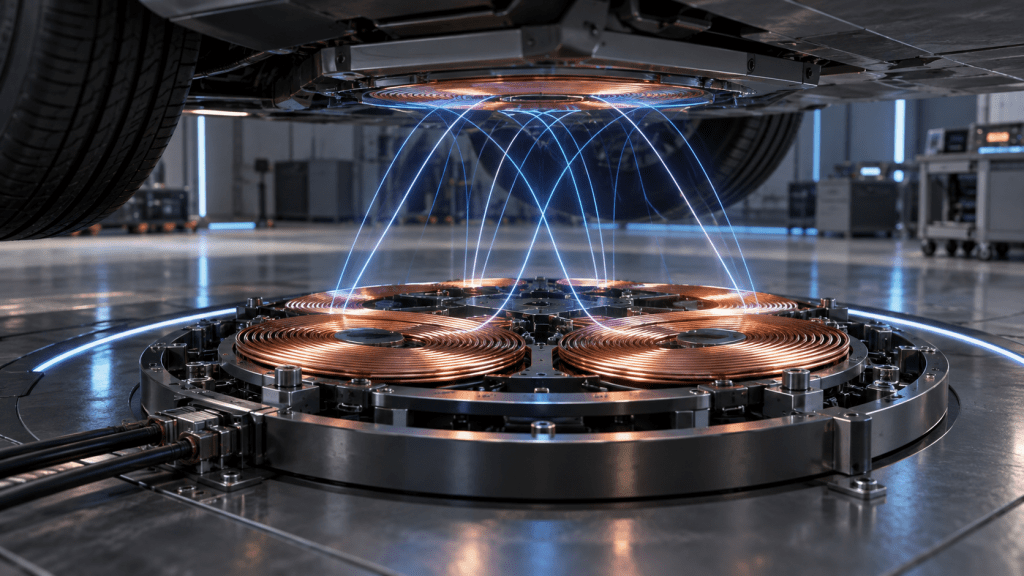
HEVO announced that it is supporting a technology evaluation program involving Oak Ridge National Laboratory (ORNL) and BMW. The company said it will contribute wireless-charging engineering experience and circular coil topologies to assist bench testing of compatibility with ORNL’s polyphase coil technology.
Wireless power transfer depends on magnetic coupling between a ground-side transmitter and a vehicle-side receiver. Coil geometry, phase control, alignment tolerance, shielding, thermal management, and power electronics all affect how efficiently energy can cross the air gap. A polyphase architecture uses multiple controlled phases to shape the magnetic field and may offer design options for power density and packaging.
The announcement describes an evaluation effort, not a completed validation. It provides no measured efficiency, transfer power, air-gap tolerance, thermal result, electromagnetic-compatibility result, cost target, or production schedule. Those details would be necessary before buyers could compare the approach with existing commercial wireless-charging systems.
Why this matters for magnetic-component suppliers
Although the system is an application of electromagnetic coils rather than a conventional permanent-magnet assembly, it is relevant to the broader magnetic-component sector. Higher-power wireless charging can create demanding requirements for litz wire, ferrite or other flux-guiding materials, shielding, insulation, potting compounds, cooling, sensing, and high-frequency power-conversion components.
For component manufacturers, early evaluation programs can reveal where future design specifications may tighten. Suppliers may need to support low-loss magnetic materials, repeatable coil winding, dimensional control, thermal stability, and electromagnetic testing. Automotive adoption would also require robust validation for vibration, temperature cycling, contamination, safety, interoperability, and long-term reliability.
Questions to ask before a sourcing decision
- Performance evidence: What power level, transfer efficiency, offset tolerance, and operating frequency have been demonstrated under repeatable conditions?
- Thermal design: How are coil, ferrite, shielding, and power-electronics temperatures controlled during sustained charging?
- Interoperability: Can the architecture work with existing vehicle and infrastructure standards, or would it require a dedicated ecosystem?
- Manufacturing readiness: Are the coil geometry, materials, and assembly process suitable for automotive-scale quality control and cost targets?
The program is a useful signal that coil topology remains an active engineering lever in next-generation EV charging. For now, the appropriate conclusion is that compatibility is being evaluated; claims about superior performance or commercial deployment should wait for published test data.
Source: PR Newswire — HEVO Works with ORNL and BMW to Advance Evaluation of Next-Generation Wireless Charging Technology (published September 21, 2026, 08:00 ET).