Summary: A University of Utah-led consortium has received a US$7.5 million U.S. Department of Energy award to evaluate critical minerals and rare earth elements in coal-related and other unconventional resources. The work could improve the domestic resource map, but it does not yet establish commercially recoverable magnet-material supply.
Research expands from individual basins to a regional resource picture
A University of Utah-led consortium received a US$7.5 million award from the U.S. Department of Energy’s Office of Fossil Energy and Carbon Management, according to KSL. The project will study potential critical-mineral and rare-earth resources associated with coal seams, mining waste and industrial waste across the Rocky Mountain region.
KSL reported that the consortium has also secured more than US$2 million in non-DOE support, bringing the stated project value to nearly US$10 million. The new phase builds on earlier basin-level work and is intended to develop a broader understanding of resource volumes and geological settings across eight regions.
Resource mapping is an early supply-chain step
For the permanent-magnet industry, unconventional resources are relevant only if they can eventually deliver the required magnet rare earths at acceptable recovery, purity, cost and environmental performance. A research award and a geological inventory do not prove that a resource is economically recoverable or ready for commercial separation.
The distinction matters because rare-earth-bearing waste or coal-associated material can vary widely in grade, mineralogy and processing behavior. A promising occurrence may still face difficult concentration, leaching, separation, residue-management and qualification challenges.
What magnet buyers should look for next
Useful future evidence would include measured grades for neodymium, praseodymium, dysprosium and terbium; reproducible recovery results; impurity profiles; pilot-scale material balances; waste-management plans; and a credible route from mixed products to separated oxides, metals, alloys and qualified magnets.
Until those steps are demonstrated, the award is best viewed as an investment in resource knowledge and technology options rather than a new source of available NdFeB feedstock.
Source: KSL, 8 October 2026.
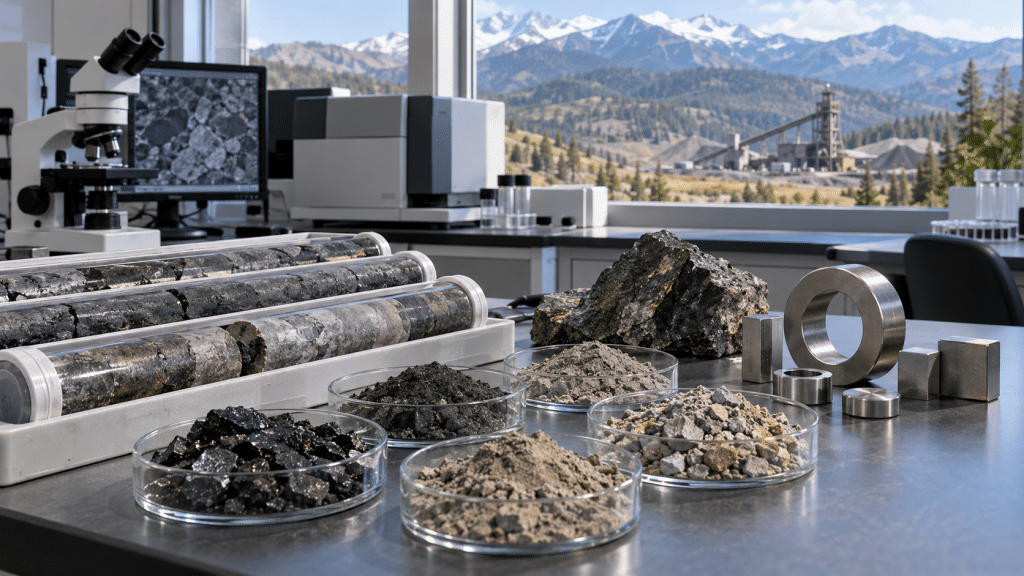
Feature image: original conceptual illustration; it is not a photograph of the named research project, a specific mine or an HK Magnet facility.