Summary: Researchers used a tightly shaped ultrafast laser beam to switch magnetic regions in a thicker multilayer material, expanding a laboratory route toward denser and faster magnetic data storage.
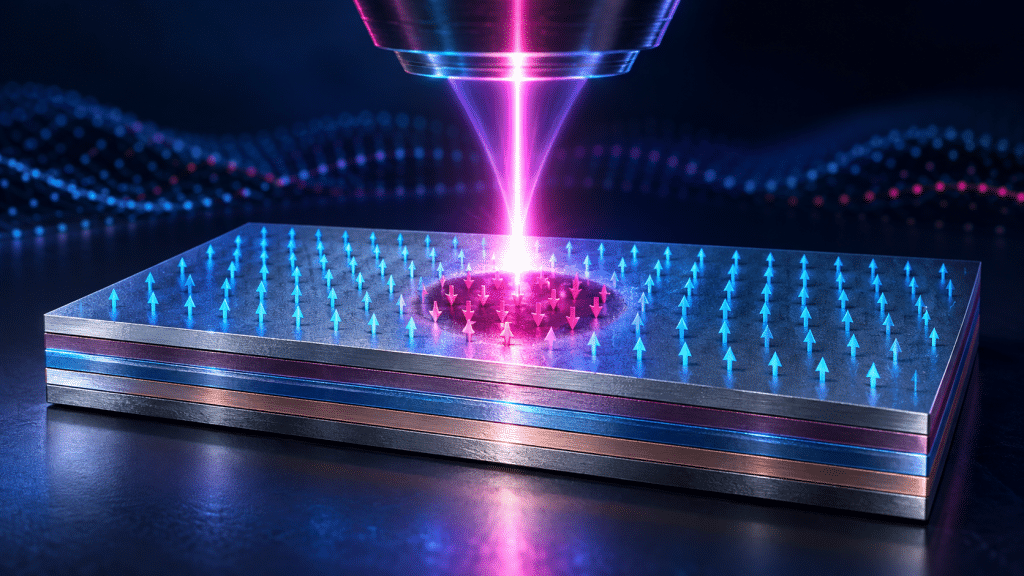
Engineers at the University of California San Diego have reported an optical method for switching magnetic states without applying an external magnetic field. The research used a specially shaped ultrafast laser beam to reverse a small magnetic region in a multilayer platinum-cobalt sample.
The study addresses two limitations of earlier optical-switching experiments: the thickness of the magnetic stack and dependence on a particular light polarization. The result remains a research demonstration rather than a commercial storage component.
A smaller optical spot can support denser switching
Magnetic data storage represents digital information through small regions with different magnetization directions. Conventional switching methods use magnetic fields, while optical switching uses short pulses of light to alter the magnetic state.
The UC San Diego team concentrated and shaped the laser beam into a very small spot. According to the researchers, reducing the switched area could help increase storage density because each magnetic region can occupy less space.
Nine magnetic layers were switched
Earlier demonstrations were generally limited to very thin magnetic stacks. The new experiment switched a sample containing nine alternating platinum and cobalt layers. It also operated without requiring the specific light polarization used in earlier approaches.
The mechanism involved repeated ultrafast pulses. Initial pulses heated a small region and created a reversed magnetic area, while later pulses expanded the region until it became stable. The researchers reported extensive repeat testing because the behavior differed from established expectations.
Potential does not equal production readiness
The source said optical switching could ultimately support faster, smaller, and more energy-efficient data storage. Those goals still require evidence beyond a laboratory material stack, including device integration, write reliability, thermal control, manufacturing yield, endurance, and system-level energy measurements.
The sample is also not a permanent-magnet product such as an NdFeB motor magnet. Its relevance to the broader magnetics industry is the control of magnetic domains and the engineering of multilayer magnetic materials for information technology.
What component developers should monitor
- Minimum repeatable switching area and error rate
- Energy used per written bit at device level
- Thermal stability and data retention
- Compatibility with scalable thin-film manufacturing
- Performance in complete read-write architectures
The research expands the design space for optical control of magnetic materials. It is a meaningful laboratory advance, but commercial impact will depend on whether the method can be integrated into durable, manufacturable storage devices.