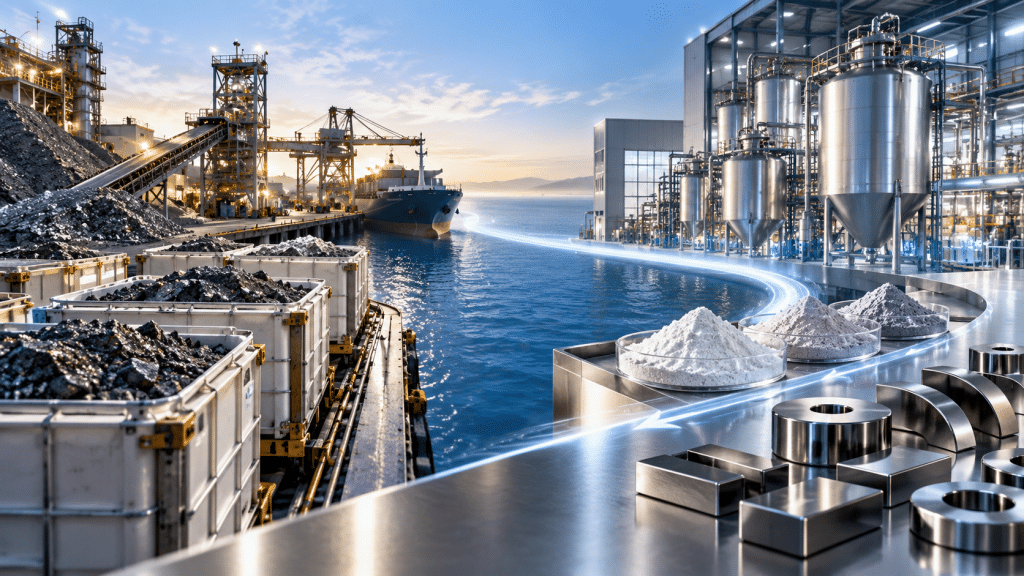
Summary: Tronox and JX Advanced Metals will jointly fund studies for a proposed Australia-to-U.S. rare-earth processing chain, but no construction decision has been announced.
Tronox and JX Advanced Metals have signed a cooperation and investment agreement covering approximately US$32 million of technical and commercial studies for rare-earth processing facilities in Australia and the United States. The two companies plan to share the study cost equally.
What the agreement covers
The work has three main parts. First, the partners will conduct a definitive feasibility study for a proposed cracking and leaching plant in Western Australia. Second, they will carry out a pre-feasibility study for a proposed rare-earth oxide refinery in the United States. Third, the program includes a U.S. pilot facility intended to produce initial quantities of high-purity rare-earth oxides.
Tronox said the Australian plant is currently planned for the Rockingham Industrial Zone near its existing Kwinana titanium dioxide operation. The proposed U.S. refinery would be located next to its Hamilton, Mississippi facility. Using established industrial sites could provide access to utilities, infrastructure and operating experience, although the economics still need to be demonstrated.
Potential relevance to permanent magnets
The proposed supply chain would target both light and heavy rare-earth elements. The company release lists neodymium and praseodymium, which are central to NdFeB magnet production, as well as dysprosium and terbium, which can support high-temperature magnet performance. It also identifies samarium, gadolinium and yttrium among the potential feedstock components.
If the studies support further investment, the two sites are currently envisioned to produce up to 10,000 tonnes per year of total rare-earth oxides. That figure is a study target, not operating capacity. The agreement does not mean that a plant has been approved, financed, built or commissioned.
What buyers and manufacturers should watch
For magnet manufacturers, the important question is whether the project can convert mineral-sands by-products into consistent, qualified oxide products at a competitive cost. Oxide production is also only one stage of the chain. Metalmaking, alloy production, strip casting, magnet manufacturing and customer qualification would still be required before the material could support finished permanent magnets.
The partners said that a future joint venture may be considered if the engineering studies show technical and commercial viability. They have also discussed potential support with government-backed and commercial lenders. Those discussions should not be treated as committed project financing.
For B2B procurement teams, the announcement is best read as an early-stage diversification signal. Useful future milestones will include completion of the studies, pilot-product specifications, environmental approvals, financing, construction decisions and evidence of customer qualification.
Source: Tronox company announcement distributed by PR Newswire, September 29, 2026.