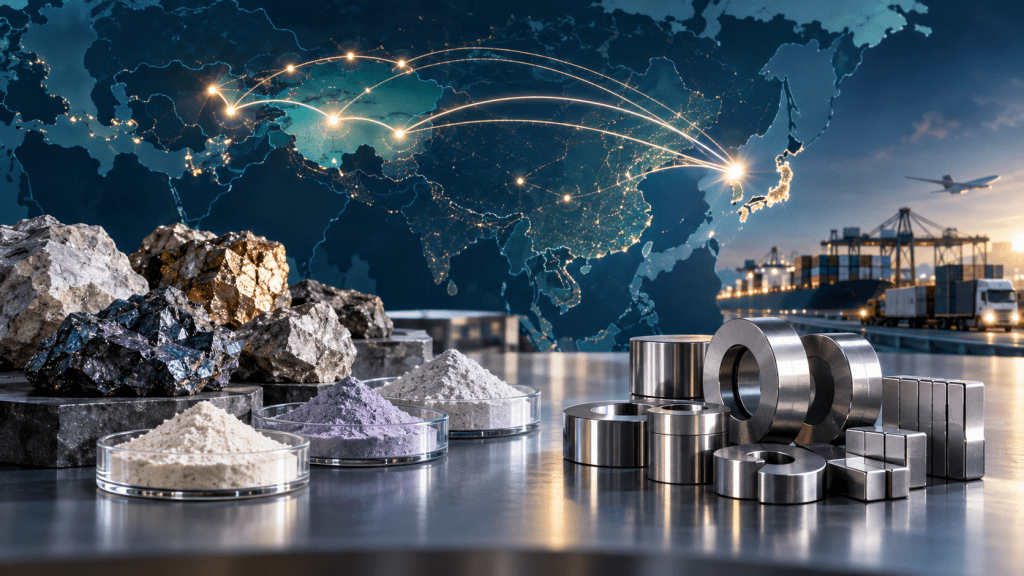
Summary: South Korea and five Central Asian countries signed a group of government-level cooperation documents covering industry and critical-mineral supply chains. The framework includes rare earths and could support longer-term diversification, but it does not by itself confirm new magnet-grade material capacity or near-term supply.
South Korea has expanded its critical-minerals cooperation with Kazakhstan, Kyrgyzstan, Tajikistan, Turkmenistan and Uzbekistan. Shanghai Metals Market reported that South Korea’s Ministry of Trade and Industry announced nine government-level industrial and supply-chain cooperation documents signed during meetings held from September 14 to 16.
The package includes one multilateral memorandum of understanding and eight bilateral agreements. Rare earths and lithium were among the materials discussed. South Korea and Uzbekistan also agreed to establish a full-cycle cooperation platform covering critical-mineral exploration and processing.
Why the framework matters to magnet supply chains
Permanent magnets require more than access to geological resources. A resilient supply chain must connect mining, mineral concentration, separation, metal and alloy production, magnet manufacturing and application-level qualification. Cooperation with Central Asian countries could widen South Korea’s options at the upstream and processing stages, where supply is concentrated and projects often require long development periods.
South Korea is a major manufacturing center for vehicles, electronics, machinery and other products that can depend on high-performance permanent magnets. A broader critical-minerals network may therefore support industrial planning even before commercial volumes reach the market.
What the announcement does not establish
The documents should be viewed as a policy and cooperation framework, not as proof that new rare-earth oxide, alloy or magnet capacity is already operating. The announcement summarized by SMM did not specify magnet-grade output volumes, project commissioning dates, binding offtake quantities or qualification milestones for NdFeB or SmCo materials.
That distinction matters for industrial buyers. Exploration and processing cooperation may eventually improve geographic diversity, but it can take years to develop a mineral deposit, build separation capacity and qualify material through downstream production. Near-term sourcing decisions should continue to rely on verified supplier capacity, traceability, lead time and quality documentation.
Private-sector participation adds breadth
SMM also reported 116 private-sector memoranda of understanding connected with the meetings and summit. The large number shows broad commercial interest across the participating countries, although an MOU is not the same as a completed investment, operating plant or contracted shipment.
Questions buyers should ask as projects develop
- Which rare-earth elements and products will each project target?
- Will output be mineral concentrate, separated oxide, metal, alloy or finished magnet?
- What commissioning, qualification and commercial-shipment dates are planned?
- Are environmental, traceability and responsible-sourcing requirements defined?
- How much capacity is covered by binding finance or offtake agreements?
Supply-chain takeaway
The new framework is a meaningful signal that South Korea and Central Asia want more structured cooperation across critical-mineral value chains. For the permanent-magnet industry, its practical effect will depend on whether the agreements advance from dialogue to financed, permitted, commissioned and qualified projects. Buyers should watch those milestones rather than treating the signing alone as immediate new supply.