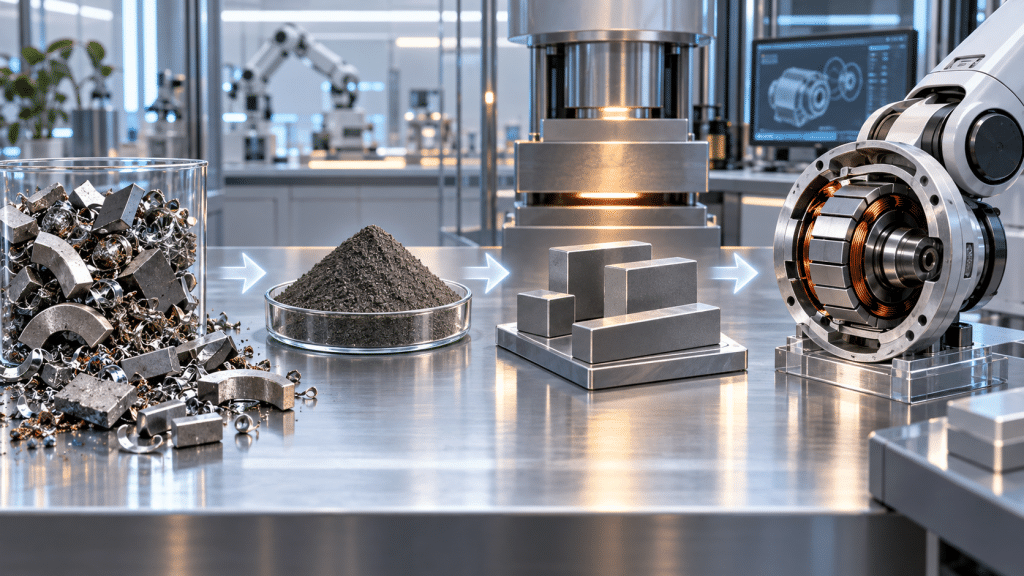
Summary: A Chinese research program says recycled sintered NdFeB material has passed a comprehensive evaluation and has been tested in humanoid-robot joint motors. The announcement is an encouraging circular-supply-chain signal, but buyers still need independently reviewable grade, process, reliability, and production-scale data before qualification.
Program links magnet waste to a motor application
A national research and development project led by Wuhan Fisher Motion Control Systems with Beijing University of Technology has reported progress in regenerating high-performance rare earth magnets from waste sintered neodymium-iron-boron material.
According to Shanghai Metals Market, the program passed a comprehensive performance evaluation administered by China’s Administrative Center for Agenda 21. The report says the team produced recycled magnets entirely from NdFeB waste and installed them in humanoid-robot joint motors for extended reliability testing.
This is more meaningful than a laboratory recovery result alone. It connects three steps that magnet buyers normally evaluate separately: recovering usable material from waste, manufacturing a magnet with repeatable properties, and testing that magnet inside an operating electromechanical system.
Why closed-loop NdFeB recycling matters
Manufacturing scrap, end-of-life motors, and rejected magnets may contain valuable neodymium and praseodymium, with some grades also containing dysprosium or terbium. Returning those materials to magnet production could reduce dependence on primary feedstock and improve material utilization.
However, the phrase “recycled magnet” does not by itself define a purchase-ready product. A qualified sintered NdFeB magnet still depends on alloy chemistry, oxygen and impurity control, powder preparation, alignment, pressing, sintering, heat treatment, machining, coating, and magnetization. Small variations can affect remanence, coercivity, maximum energy product, temperature performance, corrosion resistance, and mechanical integrity.
What motor and magnet buyers should verify
The public report describes commercial-grade performance and reliability testing, but it does not publish a complete technical data package. Engineering and sourcing teams should look for evidence in four areas:
- Feedstock control: the proportion and origin of manufacturing scrap or end-of-life magnets, plus the method used to remove coatings, adhesives, and other contaminants.
- Magnetic properties: grade-specific values for remanence, intrinsic coercivity, coercivity, maximum energy product, and irreversible loss across the intended temperature range.
- Process consistency: lot-to-lot chemistry, density, grain structure, dimensional capability, coating quality, and traceability.
- Application validation: motor duty cycle, test duration, thermal loading, vibration conditions, failure criteria, sample size, and comparison with a conventional-material control.
Robot joint motors can require high torque density, compact dimensions, and stable performance under repeated acceleration and thermal cycling. Passing an application test is therefore relevant, but the result should be interpreted within its exact test conditions rather than generalized to every motor or magnet grade.
Commercial qualification remains the next step
The reported work suggests that recycled NdFeB may move beyond simple material recovery toward demanding motor applications. The next commercial questions are whether the process can deliver stable production volumes, documented quality control, acceptable cost, and repeatable performance across multiple customer programs.
For buyers, the practical approach is to qualify recycled-content magnets against the same drawing, grade, coating, magnetization, inspection, and reliability requirements used for conventional magnets. Recycled content should be treated as an additional sourcing and sustainability attribute, not as a substitute for application-specific validation.
Source: Shanghai Metals Market — Fisher Technology Achieves Breakthrough in Recycling Rare Earth Magnets for High-End Motors (published September 23, 2026, 15:05 GMT+8).