Summary: Diversifying rare-earth mines is not enough to secure permanent-magnet supply. The decisive bottlenecks increasingly sit in separation, metals, alloys, magnet production and customer qualification.
A new Rare Earth Exchanges commentary, based on OCBC Group Research, argues that the strategic competition for critical minerals is expanding across energy, artificial intelligence, electrification and defense. The analysis says new rare-earth refining projects in Malaysia and the United States produced only a modest reduction in supply concentration between 2023 and 2025.
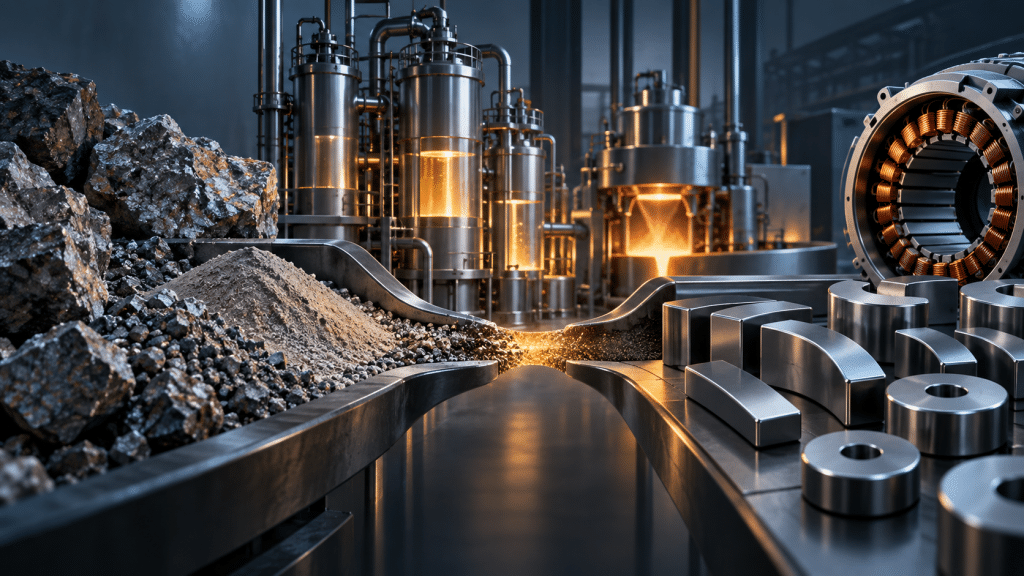
That observation does not mean new projects lack value. It means supply resilience cannot be measured by mine count alone. For permanent magnets, usable supply requires a connected chain from mineral feedstock through separation, oxide production, metals and alloys, powder preparation, magnet manufacturing, coating, magnetization and application qualification.
The bottleneck moves as capacity is added
When new mining capacity becomes available, the constraint may shift to chemical separation. When separated oxides increase, metal and alloy capacity can become the next limit. Even after magnets are produced, automotive, aerospace, robotics and industrial customers may require lengthy validation before a new source can enter regular production.
This is why announced nameplate capacity should not be treated as immediately available qualified supply. Ramp-up yield, product consistency, impurity control, intellectual property, equipment availability and customer approval can all affect the volume that reaches the market.
How buyers can assess a new supply route
A practical supplier review should map each conversion step rather than rely on a broad country-of-origin claim. Buyers can ask:
- Which company performs separation, metal making, alloy production and magnet manufacturing?
- Are those stages operating commercially, commissioning or still planned?
- What grades, temperature classes, coatings and shapes can the magnet line produce?
- Which inspection methods verify dimensions, magnetic properties and surface quality?
- What is the demonstrated output, and what portion is already committed under offtake agreements?
- Has the material passed validation in the buyer’s actual motor, sensor or assembly?
Qualification matters as much as geography
A diversified supply chain is valuable only when the alternative source can repeatedly meet the drawing and application requirements. For custom NdFeB and SmCo parts, buyers should define the required magnetic properties, geometry, tolerance, magnetization, coating, temperature, assembly method and acceptance test before comparing sources.
The commercial lesson is straightforward: mining announcements are upstream signals, not finished supply solutions. The most resilient magnet strategies combine traceable materials, proven processing, qualified manufacturing and application-level testing. That full-chain view helps buyers separate promising projects from supply that is ready for an RFQ, sampling and production approval.