Summary: Magnum Mining and Exploration reported 119 new auger-hole results from Brazil’s Piracanjuba North project, outlining four higher-response clusters with NdPr and TbDy content. The company emphasized that the reported desorption values are laboratory screening indicators, not mineral-resource classifications or commercial process recoveries.
New results expand the Piracanjuba North dataset
Magnum’s 12 October ASX release added 119 holes to the Piracanjuba North analytical database, bringing the total to 492. Of the new results, 101 holes fell within four interpreted clusters covering approximately 7.19 square kilometres inside and along the margins of the broader 32.5-square-kilometre Plateau Zone.
The company reported that 80 of the 119 new holes contained at least one original interval above 150 parts per million desorbable total rare-earth oxides, while 59 exceeded 200 ppm and 24 exceeded 300 ppm. Selected results included five metres at 626 ppm D-TREO in hole PIR-AH-0420 and five metres at 612 ppm D-TREO in PIR-AH-0491.
Light and heavy magnet rare earths appear in selected intervals
The two highlighted holes also contained desorbable NdPr and TbDy values. That combination is relevant to the magnet supply chain because neodymium and praseodymium provide the main magnetic phase in many NdFeB grades, while dysprosium and terbium can support high-temperature performance in certain formulations.
However, drill intersections and laboratory screening values are upstream exploration data. They do not demonstrate that a mine, separation plant, metal operation or magnet-production supply chain is commercially established.
Screening results are not process recovery
Magnum used a mild ammonium-sulphate solution at an initial pH of 4 to test how much ion-exchangeable rare-earth material could be released from samples. The company explicitly stated that the D-prefixed grades and apparent-desorption ratios are screening indicators rather than final metallurgical or process recoveries.
It also cautioned that the four clusters are exploration interpretations, not mineral-resource domains or classification boundaries. Several holes ended in mineralisation, but the release said those results identify priorities for deeper testing rather than proving continuation below the current drilling depth.
Next milestones will test continuity and recoverability
Magnum said about 751 metres of selective infill drilling had been completed and that it was targeting a maiden JORC mineral-resource estimate for November 2026, subject to analytical and geological inputs. Ore characterisation, mineralogy and metallurgical optimisation work are also planned, followed by an initial scoping study targeted for January 2027.
For B2B magnet buyers, the project is best viewed as an early-stage potential source of both light and heavy magnet rare earths. The important future evidence will be resource continuity, validated metallurgy, separation performance, permitting, financing and a realistic path to qualified material.
Source: Magnum Mining and Exploration ASX release, 12 October 2026.
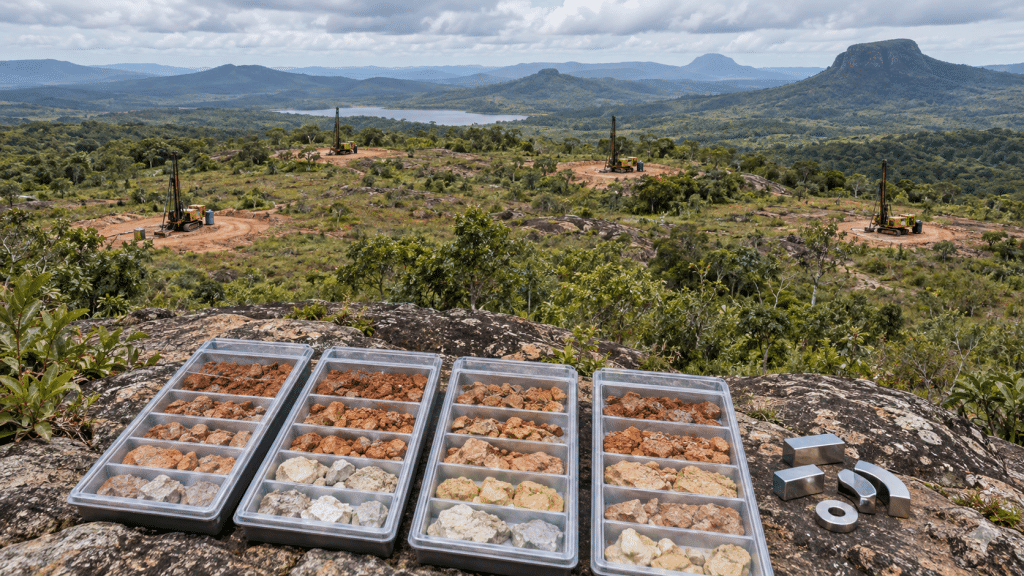
Feature image: original conceptual illustration; it is not a photograph of Piracanjuba North or an HK Magnet operation.