Summary: A newly reported Chinese utility patent describes a sintered NdFeB forming mold with radial powder-distribution channels and an auxiliary heating circuit. The design targets more uniform cavity filling and temperature control, but a patent grant does not by itself prove production performance or commercial adoption.
Patent focuses on powder flow and thermal uniformity
China’s National Intellectual Property Administration has granted a utility patent titled “A Sintered NdFeB Forming Mold,” according to a Shanghai Metals Market report. The filing is associated with Zhejiang Zhonghang New Material Technology and carries publication number CN224764315U.
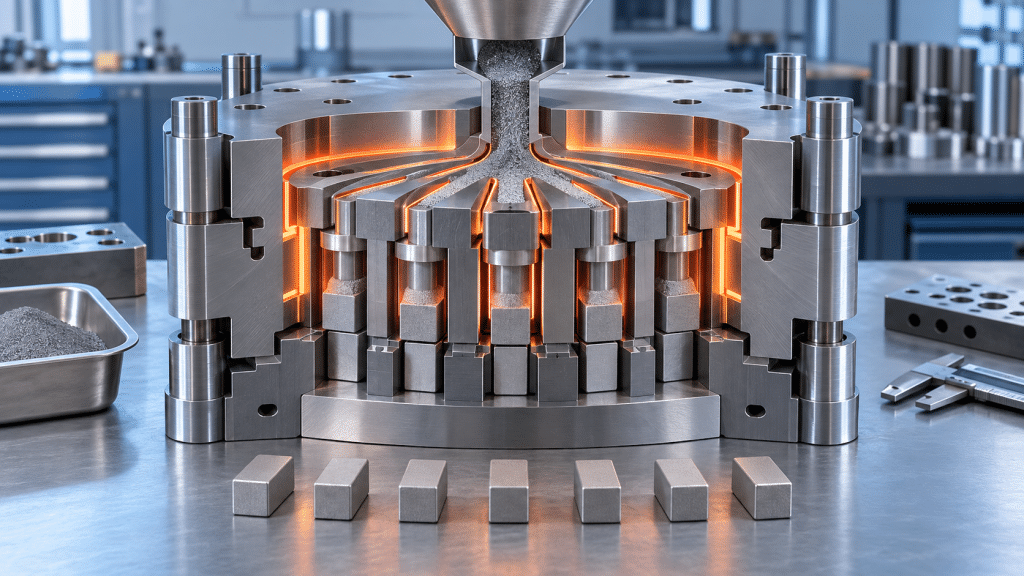
The disclosed concept uses a central feed arrangement with star-shaped grooves, distribution channels, and multiple feed holes around the forming area. The intended function is to distribute magnet powder more evenly from the center toward several mold cavities during synchronized filling.
The design also describes circular channels arranged as a connected heating path with inlet and outlet pipes. This auxiliary circuit is intended to provide more even heating and insulation around material in the forming cavities.
Why forming consistency matters for sintered NdFeB
Sintered NdFeB production depends on controlling fine alloy powder before and during compaction. Uneven filling can produce density gradients, weight variation, inconsistent green-body dimensions, or nonuniform shrinkage during sintering. These effects may later influence machining allowance, dimensional yield, magnetic consistency, and mechanical strength.
Temperature uniformity can also affect powder behavior and process repeatability, although its practical importance depends on the specific forming route, binder system, tooling, environment, and production parameters. The public patent summary does not provide enough information to determine how the heating circuit performs under industrial conditions.
For multi-cavity tooling, a balanced feed path may be particularly useful because every cavity should receive a comparable powder mass and packing condition. Even so, the tool must also support alignment-field requirements, safe handling of reactive powder, cleaning, maintenance, cycle time, and dimensional repeatability.
Questions before a production line adopts the design
A patent protects a described technical configuration; it is not equivalent to a validated manufacturing result. Magnet manufacturers evaluating a similar system would need production evidence such as:
- Cavity balance: green weight, density, and dimensional variation across every mold position.
- Magnetic consistency: lot-level distribution of remanence, coercivity, maximum energy product, and magnetic orientation.
- Thermal control: measured temperature uniformity, heating response, energy use, and the effect on powder handling.
- Yield and cycle time: scrap reduction, tooling wear, cleaning frequency, throughput, and maintenance requirements.
- Scale transfer: results across different magnet sizes, geometries, grades, and cavity counts.
Potential value is process repeatability
If the channel and heating design delivers the intended effect, its main benefit would be tighter forming consistency rather than a new magnet chemistry. Better control at the pressing stage can reduce variability that must otherwise be corrected through sorting, machining, or downstream inspection.
For B2B buyers, the relevant evidence is not whether a supplier owns or references a patent. The stronger proof is a stable capability study tied to the customer’s drawing, magnetic specification, and acceptance criteria. Future disclosures should be assessed for measured manufacturing data and industrial deployment rather than relying on the patent description alone.
Source: Shanghai Metals Market — Chinese Firm Patents Advanced NdFeB Magnet Molding Technology for Improved Quality (published September 23, 2026, 15:00 GMT+8).