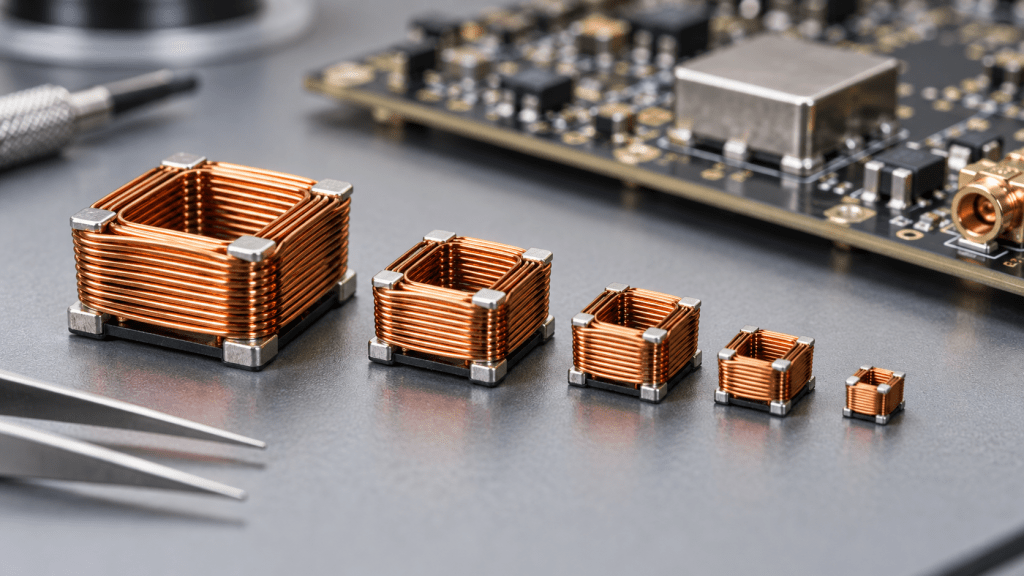
Summary: Bourns has introduced a surface-mount air coil inductor series for high-frequency receivers, transmitters, RF amplifiers and tuning circuits. The release emphasizes high Q, specified self-resonant frequency and a package shape designed for stable automated assembly.
A new air coil inductor family released on September 17 shows how magnetic-component design is adapting to compact, high-frequency electronics. Bourns says its ACXX57SQ series is intended for television and radio receivers, radio transmitters, RF amplifiers and tuning circuits.
Unlike a conventional inductor wound around a ferrite or powdered-metal core, an air coil relies on the geometry of its conductor without a magnetic core. This avoids core saturation and core-loss mechanisms, which can be useful at radio frequencies, although it also changes the inductance density, electromagnetic shielding and layout requirements.
Published electrical and mechanical range
The manufacturer lists inductance values from 90 nH to 300 nH, tolerance options of plus or minus 2% and 5%, and a typical Q value of 140 at the stated test condition. Minimum self-resonant frequencies range from 0.72 GHz to 1.15 GHz. The published maximum direct-current resistance spans 5.5 mΩ to 13.8 mΩ, while maximum rated current varies from 3.7 A to 5.7 A across the series.
The components use flat top and bottom surfaces to improve mechanical stability and compatibility with automated pick-and-place assembly. The stated operating-temperature range is -25°C to +125°C, and the series is described as RoHS compliant.
Selection points for RF designers and buyers
Inductance value is only one selection parameter. Engineers should confirm Q and impedance at the actual operating frequency, self-resonant-frequency margin, current-related temperature rise, pad layout, soldering profile, coupling to nearby components and sensitivity to board-level mechanical stress.
For procurement teams, the relevant questions include tolerance availability, packaging format, lifecycle status, sample lead time and whether the final assembly process can maintain component alignment. As with any new component release, the published specifications are a starting point; application validation should be completed on the customer’s own circuit and PCB layout.