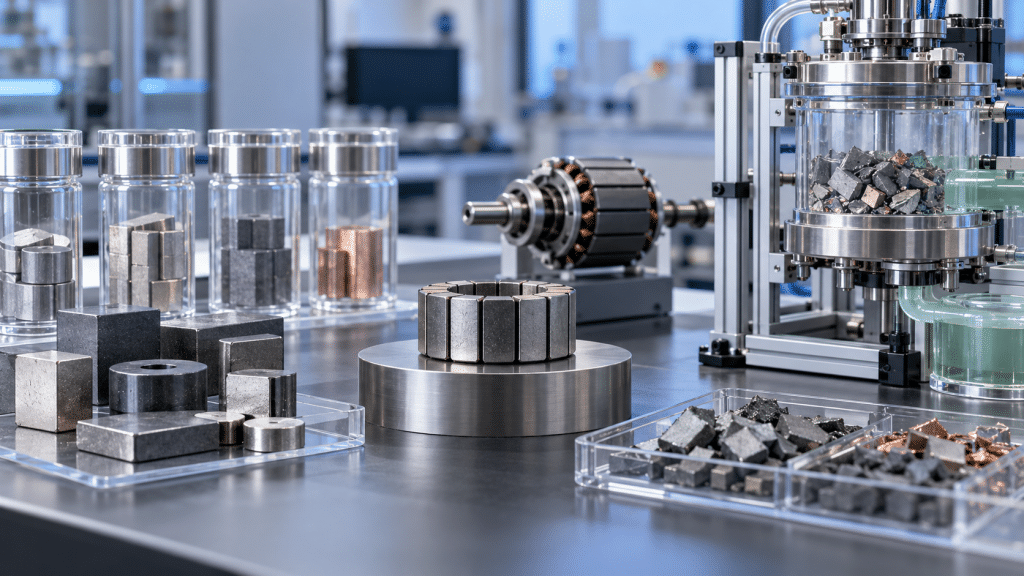
South Korea is preparing a long-term research program that links two difficult parts of the permanent-magnet supply chain: reducing the amount of rare earths needed in new magnets and recovering useful material from end-of-life magnets.
The program was described in an October 18 report by The Korean Today, which cited South Korea’s Ministry of Science and ICT. The ministry said an industry-academia-research council launched on October 1 with roughly 40 participants from magnet users, materials and recycling companies, universities, research institutes and professional societies.
Two technology tracks, not current production
The planned work has two main tracks. One aims to develop permanent-magnet manufacturing processes that avoid heavy rare earths and sharply reduce light-rare-earth use. The other aims to recover rare earths from used permanent magnets through more environmentally responsible processes. Artificial intelligence is expected to support materials screening, microstructure design and the search for recycling solvents and electrodes.
The reported schedule starts in 2027. A first phase from 2027 to 2029 is intended to build original core technologies, followed by a second phase from 2030 to 2033 for further development and industrial demonstration. These dates describe a research roadmap. They do not establish commercial output, qualified magnet grades, recovery yields or available supply.
What B2B magnet buyers should watch
For motor, robotics and industrial customers, the practical issue is whether future materials can meet the same magnetic, thermal, corrosion and lifetime requirements as established grades. A low-rare-earth formulation is not automatically a drop-in replacement. Buyers will still need grade-specific demagnetization curves, temperature limits, coating data, dimensional capability and application-level validation.
Recycled material also requires more than laboratory recovery. Commercial relevance depends on consistent feedstock, impurity control, repeatable alloy chemistry, magnet-making performance and customer qualification. Procurement teams should therefore track demonstrated specifications and pilot results rather than treating the roadmap itself as new supply.
Source: The Korean Today, published October 18, 2026 at 04:00 KST.