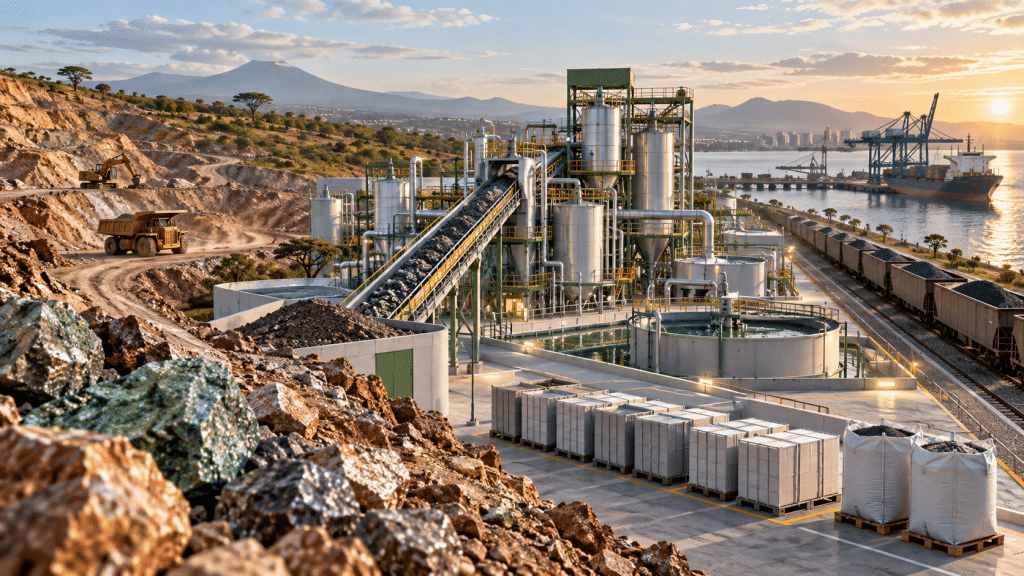
Summary: Kenya says talks with the United States on a critical-minerals partnership are at an advanced stage, with local refineries and processing plants central to the discussion. The talks and the related Mrima Hill bidding process are not yet a completed project or supply agreement.
Processing is at the center of the discussion
Kenya’s mining minister told Semafor that discussions with U.S. officials involve the possible development of refineries and processing plants in Kenya, with part of the output intended for U.S. markets. The minister also referred to possible support through special economic zones, port access, infrastructure and tax incentives.
The talks are connected to the bidding process for Mrima Hill, a coastal mineral deposit associated with rare earths and niobium. Six companies were reported to be competing, with the bidding process expected to conclude in late October before negotiations with a preferred bidder. Those details show that the development remains at the selection and negotiation stage.
Why local value addition matters
For a rare-earth project, mining is only the first step. A commercially useful supply chain must also separate individual elements, meet purity specifications, convert oxides into metals or alloys where required, and qualify products with downstream customers. Local processing can capture more economic value, but it also requires dependable power, water, logistics, technical expertise, environmental controls, financing and long-term customers.
Magnet manufacturers should therefore avoid equating an upstream resource or a government-to-government discussion with near-term NdFeB supply. The information available so far does not establish a construction decision, production schedule, qualified oxide output or a binding magnet-material offtake.
What buyers and manufacturers should watch
- The preferred bidder and the final commercial structure for Mrima Hill.
- Which minerals and finished products a proposed refinery would actually produce.
- Published recovery rates, product purity and independent technical studies.
- Power, water, transport and port commitments needed for continuous processing.
- Binding offtake, financing, permitting and a realistic commissioning schedule.
The announcement is important because it places downstream processing—not raw mineral exports—at the center of the policy discussion. Its value to the permanent-magnet supply chain will depend on the technical and commercial details that follow.
Source: Semafor — Kenya in ‘advanced’ talks with US on critical minerals deal: minister