Summary: A reported US$150 million expansion in Stepnogorsk, Kazakhstan, would modernize an existing rare-earth processing plant and add mixed rare-earth carbonate capacity. For permanent-magnet buyers, the plan is relevant as an upstream diversification signal, but the announced tonnage remains a target rather than qualified magnet-material supply.
Stepnogorsk project adds a downstream rare-earth target
Silkway Metals, a unit of Australia-based Lindian Resources, plans to invest US$150 million in a rare-earth processing expansion in Kazakhstan’s Akmola region, according to Interfax, citing the regional administration. The reported program covers modernization of the existing Stepnogorsk plant and construction of a new unit for mixed rare-earth carbonate, commonly shortened to MREC.
The project is scheduled across 2026-2028. Interfax reported that about US$50 million is intended for the existing facility and US$100 million for the new MREC unit. Preparatory work has reportedly begun.
Capacity figures are targets, not current output
The announced design case would process approximately 12,500 tonnes of monazite concentrate per year into about 8,000 tonnes of MREC. These figures describe planned capacity. They should not be read as evidence that the facility is already operating at that rate or that all output will meet a particular magnet manufacturer’s specification.
The source also reported a target for first MREC production in the fourth quarter of 2026. Commissioning, stable recovery, product consistency and customer qualification would still have to be demonstrated before the material could be treated as dependable commercial feedstock.
Why it matters to permanent-magnet procurement
MREC is an intermediate material, not a finished magnet. It normally requires further separation into individual rare-earth products, conversion to metals and alloys, magnet production and application-specific qualification. A new or expanded carbonate source can therefore widen the upstream project pipeline without immediately removing bottlenecks in separation, metallization or NdFeB manufacturing.
For procurement teams, useful follow-up questions include the source and consistency of the monazite concentrate, the planned rare-earth distribution, the location of subsequent separation, product specifications, commissioning milestones and confirmed offtake arrangements. Those details will determine how much of the planned capacity can ultimately support qualified permanent-magnet programs.
Source: Interfax, 8 October 2026.
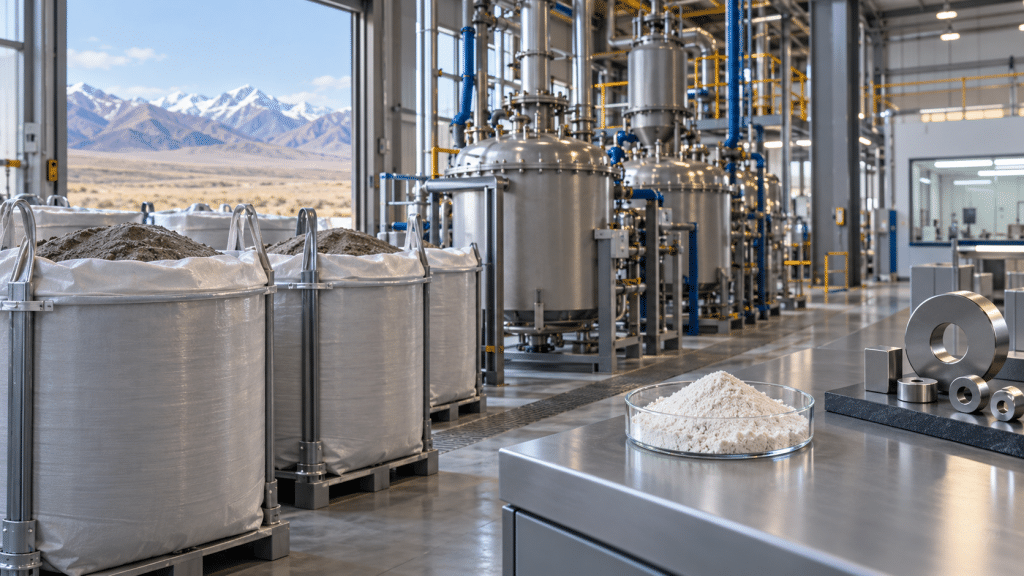
Feature image: original conceptual illustration; it is not a photograph of the named project or an HK Magnet facility.