Summary: A September 12 market report said critical minerals, including rare-earth elements, were discussed around India-Russia talks held before the BRICS summit. The article pointed to potential cooperation in processing and supply, while explicitly noting that no government statement had detailed a specific agreement. For magnet buyers, the development is a diversification signal rather than a new source of qualified material.
Rare-earth processing enters the bilateral discussion
HDFC SKY reported that critical minerals featured in discussions surrounding a meeting between Indian Prime Minister Narendra Modi and Russian President Vladimir Putin. The article identified lithium, rare-earth elements, titanium, nickel, molybdenum and caesium among the materials under consideration as the two countries explore wider industrial cooperation.
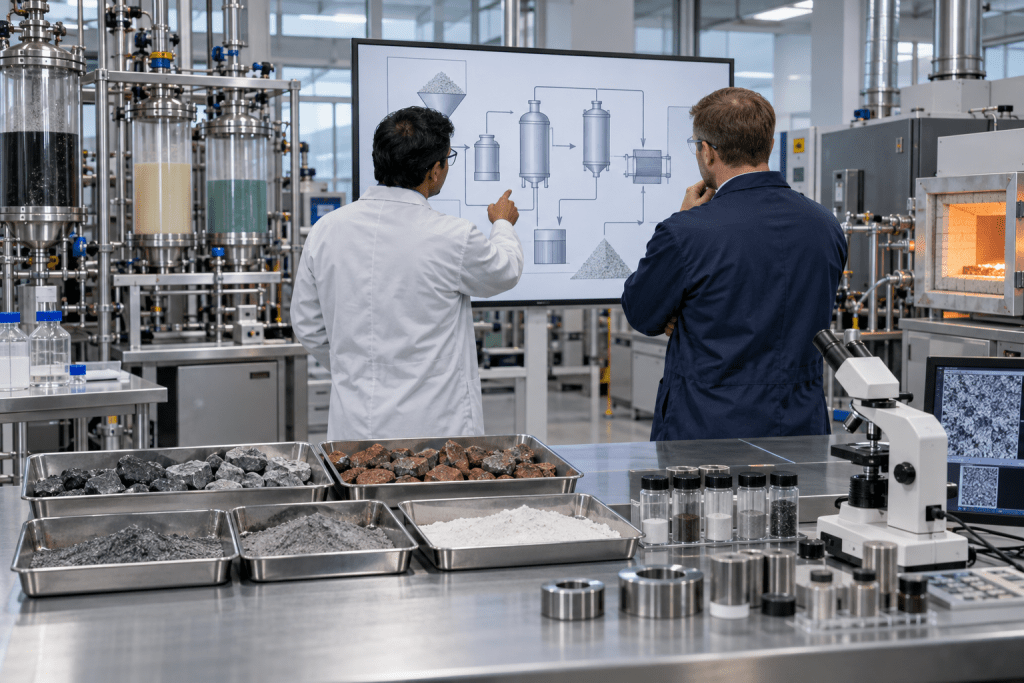
Rare-earth processing is particularly relevant to permanent magnets because the supply chain extends well beyond mining. Ore or mineral concentrate must be separated into suitable oxides, converted into metals and alloys, and then manufactured into magnets that meet application-specific chemistry, coercivity, thermal and dimensional requirements.
No specific supply agreement has been announced
The source said no government statement detailing a specific critical-minerals agreement had been issued when the article was filed. It described possible joint ventures and long-term supply contracts as subjects for future working-level discussion, not completed transactions.
That distinction matters. A political or industrial dialogue can improve the conditions for future investment, but it does not confirm funding, processing capacity, commercial output, product specifications or delivery dates. Logistics, sanctions exposure, project economics and qualification requirements would also need to be assessed before a new route could support regular magnet production.
What magnet procurement teams should watch
For buyers of NdFeB magnets and magnetic assemblies, the next useful indicators would include a formal intergovernmental framework, named project participants, defined feedstock and processing locations, financing commitments, environmental approvals, commissioning milestones and test data for separated oxides or alloy.
Even if cooperation advances, supplier qualification should remain evidence-led. Buyers should verify traceability, impurity limits, batch consistency, export-control exposure and the ability to convert processed rare earths into magnet grades at commercial scale. Until those details are available, the talks are best viewed as a potential diversification pathway rather than a replacement for established supply.
Source: HDFC SKY, September 12, 2026.