Summary: Greenland Mines says it has raised more than $42 million and completed a 2026 geological field program at the early-stage Sarfartoq NdPr project. The funding and field work support further evaluation, but new samples have not yet produced assay results and the announcement does not establish future magnet-material production.
Financing supports planned project milestones
Greenland Mines has announced more than $42 million in funding from existing investors through a registered direct offering, pre-funded warrants, and the exercise of earlier private warrants. The company says the proceeds are intended to support planned exploration and development work across its Greenland portfolio through targeted 2027 milestones.
The company also terminated its at-the-market offering facility after completing the financing. This reduces one near-term funding uncertainty, but it does not remove the technical, permitting, environmental, infrastructure, logistics, market, and execution risks that remain for a mineral-development project.
Sarfartoq field program moves into laboratory analysis
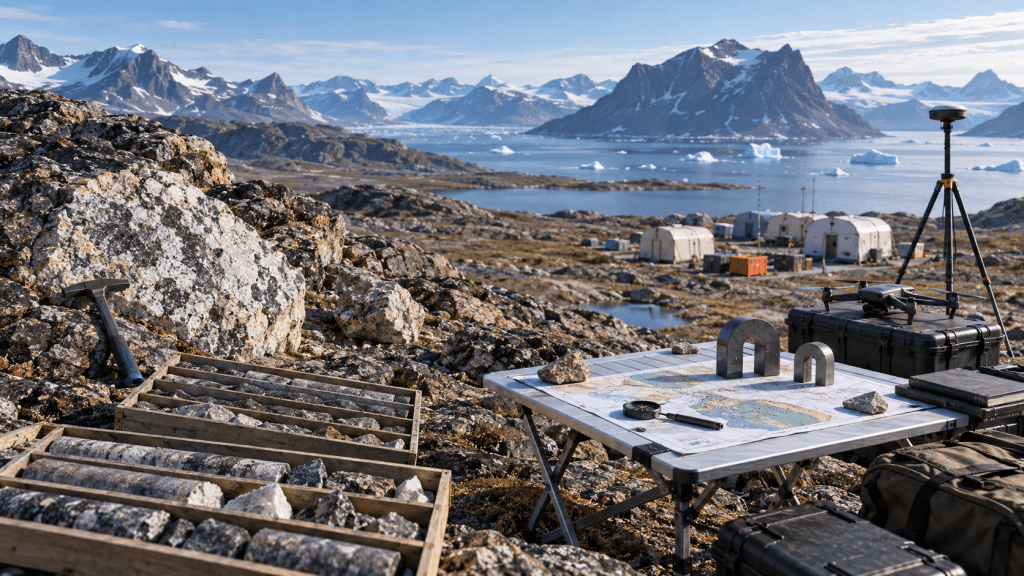
At the Sarfartoq neodymium-praseodymium project in southwest Greenland, the 2026 field team completed geological and structural mapping, drone-supported outcrop surveys, and systematic rock sampling across selected parts of the carbonatite complex.
The work was designed to improve the three-dimensional geological framework around the existing ST1 area and refine targets for future drilling and resource-upgrade programs. The team also sampled carbonatites, rare earth mineralization, and newly observed carbonatite-dyke occurrences.
Those samples are expected to be sent to a Canadian laboratory for rare earth element analysis. Environmental baseline work was completed for a second consecutive year, and the field camp was winterized so that preparatory activity can restart ahead of the main 2027 season.
Existing resource is not a new assay result
The announcement repeats an existing ST1 mineral-resource figure of about 12.2 million tons at 1.32% total rare earth oxides. It also cites an earlier initial assessment. These figures describe prior project work; they should not be treated as results from the newly completed field program.
The company explicitly states that assays from the new samples have not yet been received. The newly observed occurrences therefore have no established grade, width, continuity, tonnage, or economic viability in this update.
What the magnet supply chain should watch next
Neodymium and praseodymium are core inputs for high-performance NdFeB magnets. A successful new source could eventually contribute to geographic diversification, but the path from an exploration sample to magnet-ready material contains several qualification gates:
- Assay and mineralogy: confirmed NdPr distribution, deleterious elements, mineral hosts, and spatial continuity.
- Metallurgy: repeatable recovery into a concentrate that can be economically separated and refined.
- Environmental and permitting work: accepted baseline studies, approvals, community engagement, and operating conditions.
- Infrastructure and logistics: energy, water, transport, seasonal access, and a practical route to downstream processing.
- Product qualification: conversion to separated oxides, metals, alloys, and magnets that meet customer specifications.
The financing and completed field campaign are measurable project-development steps. The next evidence should come from laboratory assays, updated geological interpretation, drilling results, metallurgical work, and permit progress. Until those results are available, the announcement is best understood as funding and exploration execution rather than proof of commercial supply.
Source: Greenland Mines — Greenland Mines Completes $12-Per-Share Equity Financing and Sarfartoq Rare Earth Field Program (published September 24, 2026, 00:21 ET).