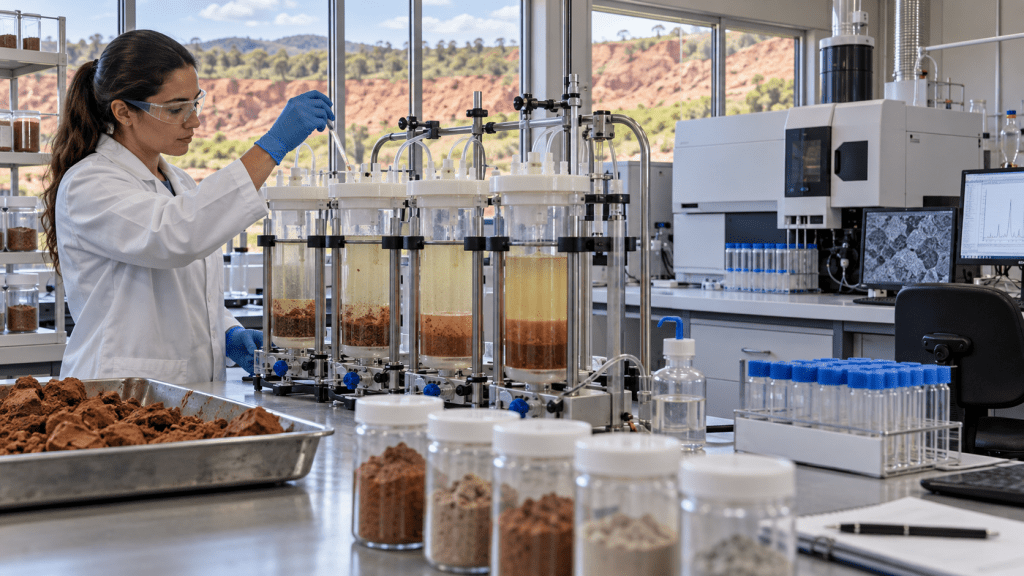
Summary: A September 11 industry report highlighted laboratory testwork from Brazil’s Itarantim ionic-clay project, where one composite reached a peak terbium recovery of 95.2% and a mixed rare earth carbonate was produced. The results are technically relevant to high-temperature NdFeB supply chains, but they remain laboratory-scale and do not establish commercial production.
Testwork reports strong terbium leaching
Mining Weekly reported that laboratory-scale metallurgical tests on material from the Itarantim project produced encouraging recoveries for the four main magnet rare earths: neodymium, praseodymium, dysprosium and terbium. In the best-performing composite, terbium recovery averaged 81.1% and reached a maximum of 95.2% in individual tests.
The reported average recoveries for the same composite were 66.1% for neodymium, 36.5% for praseodymium and 46.1% for dysprosium. The work also produced a mixed rare earth carbonate, an intermediate material that would require additional processing before separated oxides, metals, alloys or finished permanent magnets could be manufactured.
Peak recovery is not a production guarantee
The 95.2% figure is a peak laboratory result, not a whole-resource recovery rate or a commercial plant guarantee. Performance can vary with sample composition, reagent conditions, residence time, scale and the need to control impurities. Further quantitative testwork has been commissioned to better define recovery performance and the characteristics of the carbonate product.
The project is also reported on the basis of an inferred mineral resource. Inferred resources carry geological uncertainty and do not demonstrate economic viability. Engineering, environmental review, permitting, financing and pilot-scale validation would all be required before a dependable supply schedule could be assessed.
What the result means for magnet sourcing
Terbium and dysprosium are important to selected NdFeB grades used where temperature resistance and coercivity are critical. A future diversified source could therefore matter to motor, robotics, wind, electronics and defence supply chains. However, magnet buyers cannot qualify a mine project directly from a headline recovery percentage.
Procurement teams should track representative-sample testing, impurity specifications, batch consistency, pilot-plant mass balance and the downstream partner responsible for separation and metal or alloy conversion. For active RFQs, buyers should continue to compare finished-magnet performance, traceability and delivery capability rather than assume that upstream exploration results will quickly change price or availability.
Source: Mining Weekly, September 11, 2026.