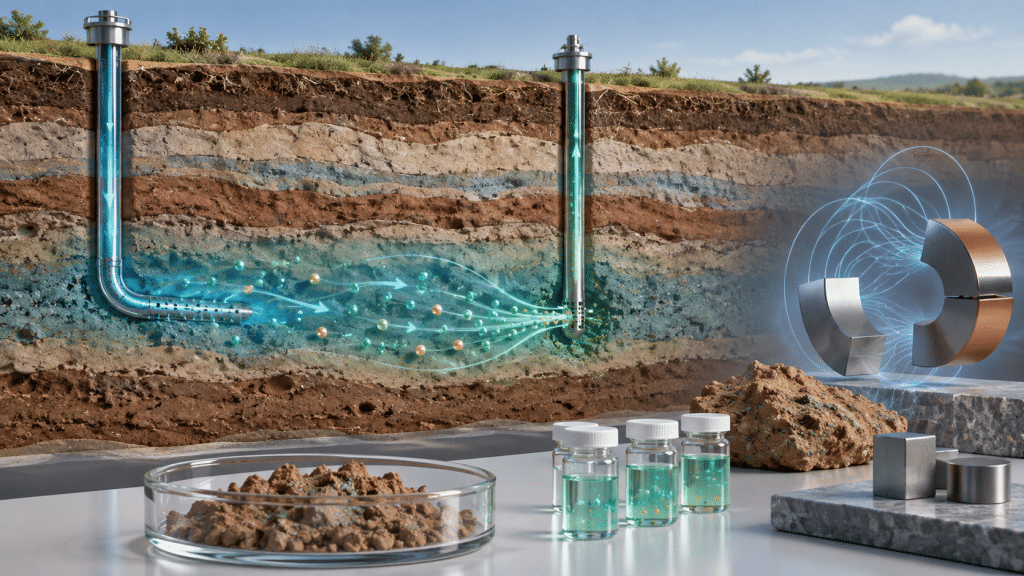
Summary: Laboratory column tests on rare-earth-bearing clay from Brazil recovered a reported 73% of the tested rare earths, excluding cerium, and produced intermediate rare earth products. The results support further evaluation of in-situ recovery, but field performance, project economics, permitting, and magnet-grade product qualification remain unproven.
Laboratory work tests a different recovery route
IMC Rare Earths reported new metallurgical results from University of Brighton testwork on material from the Itarantim project in Brazil. The program evaluated whether an acidified magnesium sulphate solution could mobilize rare earth elements from ionic-adsorption clay in a column-test setting.
According to the company, the tests recovered 73% of the total rare earth elements evaluated, excluding cerium. Reported recoveries included 71.4% for terbium and 70.5% for dysprosium, both of which are relevant to high-temperature permanent-magnet applications. The announcement also said the column leach solutions contained 4,000 to 8,000 milligrams per litre of total rare earths.
Further processing produced a mixed rare earth carbonate, with up to 86.6% recovery from the leach solution at that stage, followed by a mixed rare earth oxide containing about 41% total rare earths. These percentages describe different steps in the test sequence and should not be combined or treated as a single end-to-end commercial recovery rate.
Why in-situ recovery is being evaluated
The concept under review would circulate a leaching solution through rare-earth-bearing clay using injection and recovery wells instead of excavating and processing the entire deposit in a conventional open pit. If field trials eventually confirm controllable fluid movement and acceptable recovery, the approach could reduce excavation, material handling, and tailings requirements.
That possibility is not yet a project outcome. The company stated that hydrogeological work and field-scale injection and recovery testing are still required. It also identified questions involving fluid flow and the movement of fine clay material. Engineering studies, environmental review, permitting, capital requirements, and operating costs remain future work.
What the update means for magnet-material buyers
The project contains reported occurrences of neodymium, praseodymium, dysprosium, and terbium, connecting the testwork to the permanent-magnet supply chain. However, laboratory recovery of mixed rare earth material is several stages away from a qualified input for NdFeB magnet production.
Procurement and engineering teams should watch for evidence in four areas:
- Field performance: whether injection and recovery can be controlled across the deposit under real hydrogeological conditions.
- Impurity management: the composition of recovered solutions and the repeatability of downstream purification.
- Separated products: whether mixed carbonate or oxide can be economically separated into consistent, specification-grade rare earth oxides.
- Commercial pathway: permitting, pilot-scale mass balance, reagent consumption, water management, capital needs, and a realistic development schedule.
The announcement is therefore best read as encouraging laboratory evidence for a possible recovery route, not as confirmation of commercial production or near-term magnet supply.
Source: IMC Rare Earths — IMC Rare Earths Reports 73% In-Situ Rare Earth Recovery, Supporting Potential Lower-Cost Recovery at Itarantim (published September 22, 2026, 08:00 ET).