Summary: Cyclic Materials has opened a commercial-scale facility in Mesa, Arizona, designed to process up to 25,000 metric tons of magnet-bearing end-of-life products each year. Commercial operation has begun, but the plant’s stated input capacity should not be confused with an equivalent output of separated rare earths or finished magnets.
Commercial magnet recovery begins in Arizona
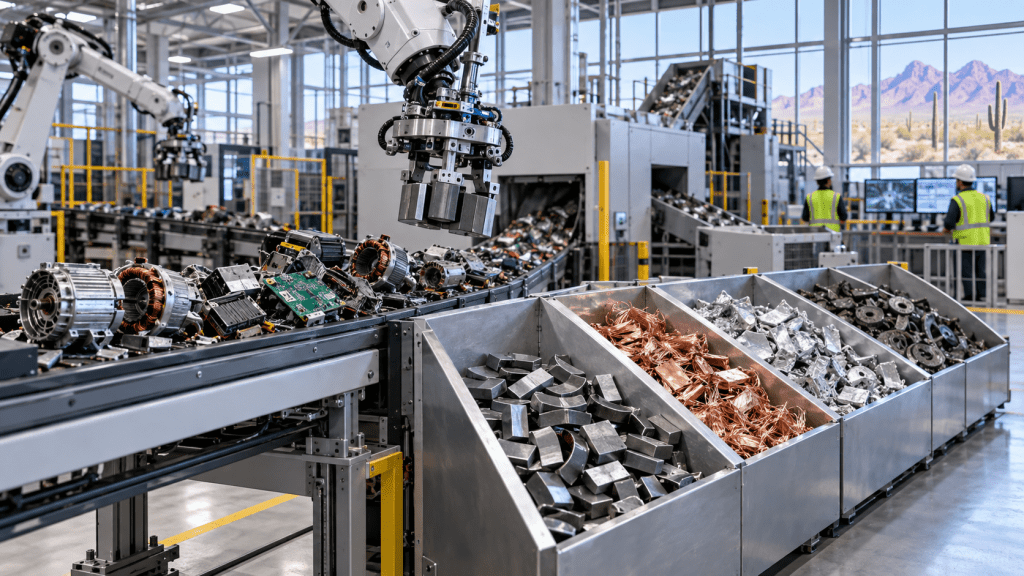
Cyclic Materials announced on September 9 that its Mesa facility is operating with an annual processing capacity of up to 25,000 metric tons of magnet-bearing end-of-life products. The site uses the company’s automated mechanical separation technology to remove magnets from discarded products and produce a rare-earth magnet material, alongside recovered copper, aluminum and steel.
The company said more than 7,000 metric tons of material had already been delivered to the facility and that first commercial shipments to U.S. customers were expected later in September. That provides a stronger operational signal than a project announcement alone, although customers will still need data on composition, purity, consistency and shipment specifications.
Input capacity is not finished-magnet capacity
The 25,000-tonne figure describes the amount of magnet-bearing products the facility can process. End-of-life motors, electronics and other assemblies contain housings, copper, steel, aluminum and non-magnetic material in addition to permanent magnets. Actual rare-earth-bearing output will therefore depend on feedstock mix, magnet content, recovery yield and product specification.
The Mesa plant serves as the mechanical-recovery front end of a broader recycling chain. Cyclic Materials is also developing a South Carolina campus intended to combine magnet recovery with rare-earth refining. Returning recovered material to new NdFeB production still requires downstream separation, refining, alloying and magnet-manufacturing stages.
Questions for buyers and recycling partners
Manufacturers evaluating recycled rare-earth inputs should ask for batch chemistry, impurity limits, sampling methods, chain-of-custody records and the mass-balance basis used for recycled-content claims. Suppliers of end-of-life equipment should clarify accepted assemblies, contamination limits, logistics, ownership of recovered value and reporting requirements.
The opening adds a practical route for recovering magnets already present in U.S. products. Its commercial importance will become clearer as shipment volumes, recovery yields and customer qualification results emerge. Those operating metrics will determine how quickly the new capacity contributes to a repeatable circular magnet supply chain.
Source: Cyclic Materials, September 9, 2026.