Summary: Researchers created a particle-based anti-spin-ice system in which magnetic interactions favor high topological charge, providing a new experimental platform for studying programmable order and frustration.
A study published in Nature Communications on September 26, 2026 reports the experimental realization of an “anti-spin ice.” Unlike conventional artificial spin-ice systems, which tend to minimize local topological charge, this platform is designed so the particles favor states with maximum charge.
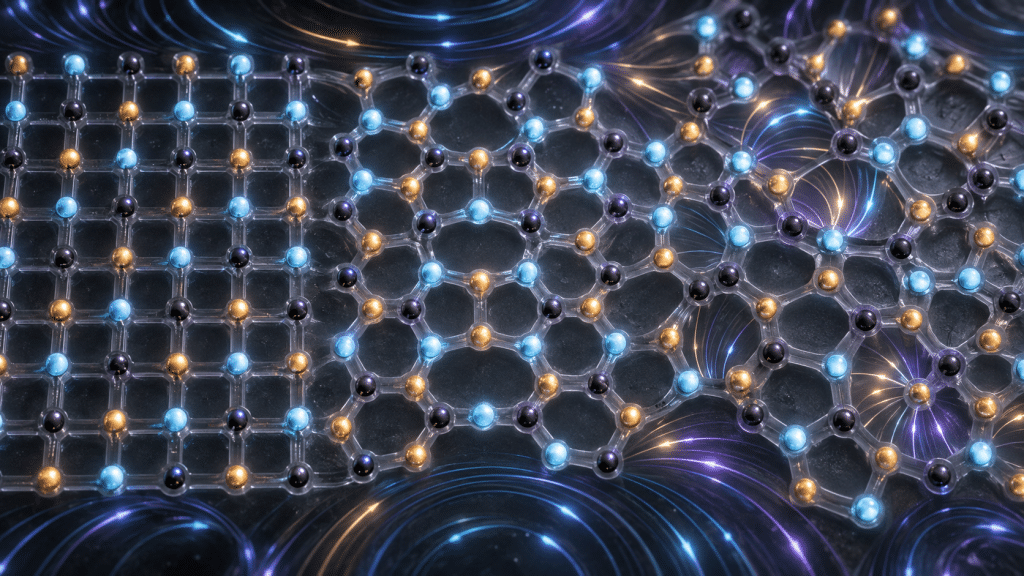
The researchers used magnetically responsive colloidal particles placed in patterned traps. Fast-rotating in-plane magnetic fields generated tunable, approximately isotropic attraction between the particles. By changing lattice geometry and interaction strength, the team observed different forms of charge ordering and frustration.
How anti-spin ice reverses the usual rule
In conventional spin ice, local constraints often favor low-charge arrangements and create many possible states with similar energy. The new experiment reverses that tendency: attractive interactions favor high-charge vertices.
Square and honeycomb lattices developed staggered charge ordering as the interaction increased. A pentaheptite lattice made from unequal, odd-sided polygons behaved differently. Its geometry prevented all local high-charge preferences from being satisfied at the same time, producing what the authors describe as topological charge frustration.
Why the geometry matters
The work separates two design variables that are often considered together: the sign of the particle interaction and the connectivity of the lattice. Changing either one can alter whether the system becomes ordered, remains frustrated, or supports a large set of accessible states.
This makes the platform useful for testing how local rules create global material behavior. Colloidal systems are especially valuable for this purpose because individual particles can be imaged directly, allowing researchers to compare experiments with simulations in detail.
Industrial relevance is long term
Artificial spin-ice research can inform future work on programmable materials, topological states, collective dynamics, and unconventional information-processing concepts. The current experiment does not demonstrate an industrial permanent magnet, a commercial sensor, or a production-ready memory component.
It also should not be interpreted as a new NdFeB or SmCo grade. The particles and patterned lattices are a controlled model system for fundamental materials research rather than a substitute for sintered permanent magnets.
What to watch next
- Faster and more repeatable switching between charge configurations
- Scaling from colloidal test platforms to nanoscale magnetic structures
- Direct control of transport or signal-processing functions
- Robustness against fabrication variation and thermal noise
- Clear device benchmarks against conventional magnetic architectures
The immediate contribution is a new experimental design principle: magnetic frustration can be engineered not only by geometry, but also by reversing the interaction rule that particles are trying to satisfy.
Source: Nature Communications — Emergent charge crystallization and frustration in a particle anti-spin ice