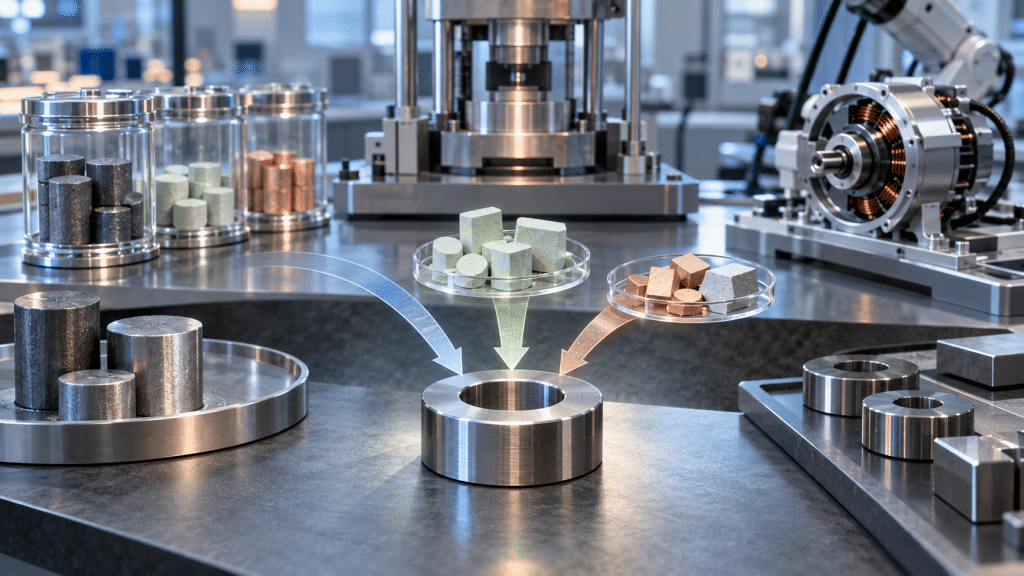
Summary: MH Materials and the Korea Institute of Materials Science have agreed to jointly develop and commercialize a permanent-magnet technology that the partners say could use 30% less neodymium, substitute cerium, and avoid dysprosium and terbium. The program is still at the joint-research and pilot-validation stage.
Joint development targets lower rare-earth exposure
MH Materials signed a memorandum of understanding with the Korea Institute of Materials Science (KIMS) on October 16 to develop and commercialize a next-generation permanent magnet under the MH HIMAG name. The planned work will combine KIMS materials and hot-deformation research with MH Materials’ manufacturing capabilities.
According to the company information reported by ChosunBiz, the proposed formulation is designed to reduce neodymium use by 30%, replace part of that input with cerium, and eliminate the heavy rare earths dysprosium and terbium. The partners have not announced completed customer qualification or commercial shipments, so the performance and cost claims should be treated as development targets rather than established production results.
Pilot production comes before scale-up
MH Materials plans to build a pilot line with annual capacity of 50 tonnes and initially apply the material to motor magnets for robot actuators being developed by an affiliate. Prototype production and customer validation are intended to precede any larger expansion.
The company is reviewing a staged path from 1,000 tonnes to 10,000 tonnes of annual capacity, but said expansion would depend on market demand and orders. That makes the 50-tonne pilot the most concrete near-term milestone. The memorandum also anticipates future technology-transfer terms, which have not yet been finalized.
What magnet buyers should monitor
Reducing neodymium and removing dysprosium and terbium could lower exposure to volatile inputs, especially for applications that need strong coercivity. However, buyers will still need application-level evidence covering magnetic properties, irreversible loss at temperature, corrosion protection, dimensional consistency and production repeatability.
For robot-actuator and compact-motor programs, the practical question is not simply whether rare-earth content is lower. Procurement teams should compare the new material with qualified NdFeB grades under the same temperature, load, geometry and lifetime conditions. Until prototypes pass those tests and customers approve the process, the project remains a promising development program rather than a commercial substitute.
Source: ChosunBiz report, October 16, 2026.