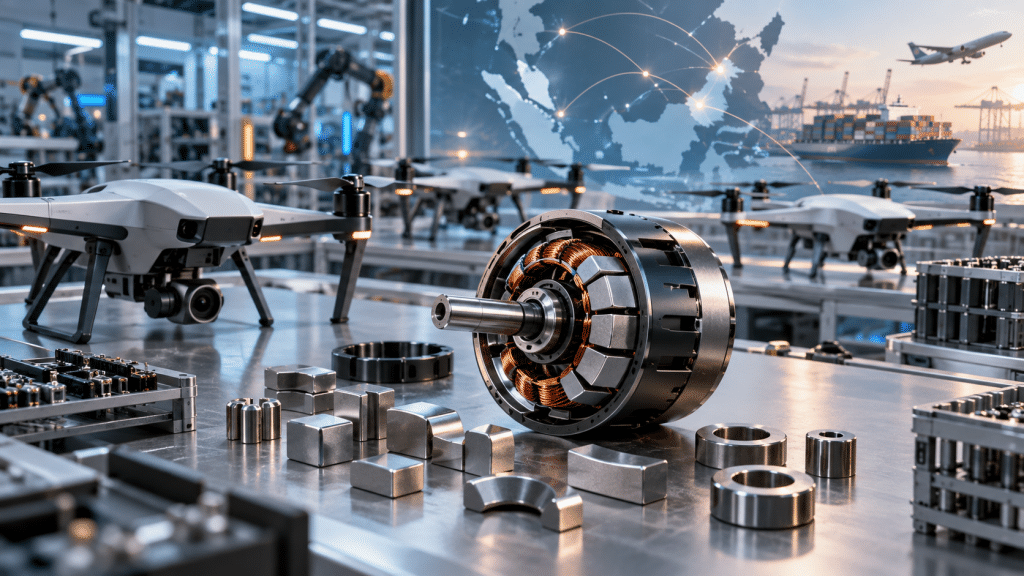
Summary: Malaysia’s growing role in drone manufacturing highlights a less visible sourcing challenge: the brushless motors inside unmanned aircraft still depend on qualified permanent magnets and a traceable upstream materials chain.
Malaysia is becoming an important manufacturing base for commercial drones, electronics and precision components. A new Rare Earth Exchanges analysis, drawing on U.S. Federal Aviation Administration data and Malaysian industry sources, says Malaysia supplied about 348,400 micro and small unmanned aircraft to the United States in 2024. The report estimates that Malaysian-origin units accounted for 84% of U.S. micro-drone imports and 57% of small-drone imports that year.
Those figures describe final aircraft trade, not the origin of every motor, magnet or rare-earth input. The source also cautions that the named Malaysian companies have not been proven to account collectively for the reported import total. For B2B buyers, that distinction matters: a drone can be assembled in one country while its motor magnets, alloy and separated rare-earth feedstock come from several other jurisdictions.
Why NdFeB magnets matter inside drones
Many compact brushless motors use high-performance permanent magnets to deliver strong torque and power density in a small, lightweight package. Sintered NdFeB is often considered where size, weight and efficiency are critical. The final material choice, however, depends on motor temperature, required magnetic performance, corrosion exposure, mechanical design and cost.
A sourcing shift at the drone-assembly level therefore does not automatically create a diversified magnet supply chain. A resilient chain must connect qualified rare-earth separation, metal and alloy production, magnet manufacturing, coating, magnetization, motor assembly and final validation. Any weak link can affect lead time, compliance or repeatability.
What drone and motor buyers should verify
Procurement teams evaluating a new motor or magnet supplier should look beyond the country printed on the finished drone. Useful questions include:
- Which magnet material and grade does the motor design require?
- What is the expected operating and peak temperature?
- Where are the magnet, alloy and critical rare-earth inputs produced?
- Can the supplier provide dimensional, coating and magnetic-property inspection records?
- Has the magnet been validated in the intended rotor, adhesive and duty cycle?
- Is there a second qualified source for the same drawing and performance window?
A practical opportunity for suppliers
Malaysia’s electronics and precision-manufacturing base could make it a useful bridge in a more diversified drone ecosystem. Yet the opportunity is not simply to move final assembly. Motor makers and drone OEMs need technically qualified magnet partners that can support drawing review, material selection, coating choice, batch traceability and sample-to-production consistency.
For a custom magnet quotation, buyers should provide the material or target magnetic properties, complete dimensions and tolerances, magnetization direction, coating, operating temperature, assembly conditions, annual volume and validation method. That information lets a manufacturer assess feasibility before tooling or production begins.
Source: Rare Earth Exchanges — Malaysia’s Drone Boom: A New Pillar of the Ex-China Supply Chain?