Summary: A French pilot line has reported repeatable production of N45UH-grade NdFeB magnets, marking a manufacturing milestone while commercial scale, customer qualification, and recycled feedstock integration remain future steps.
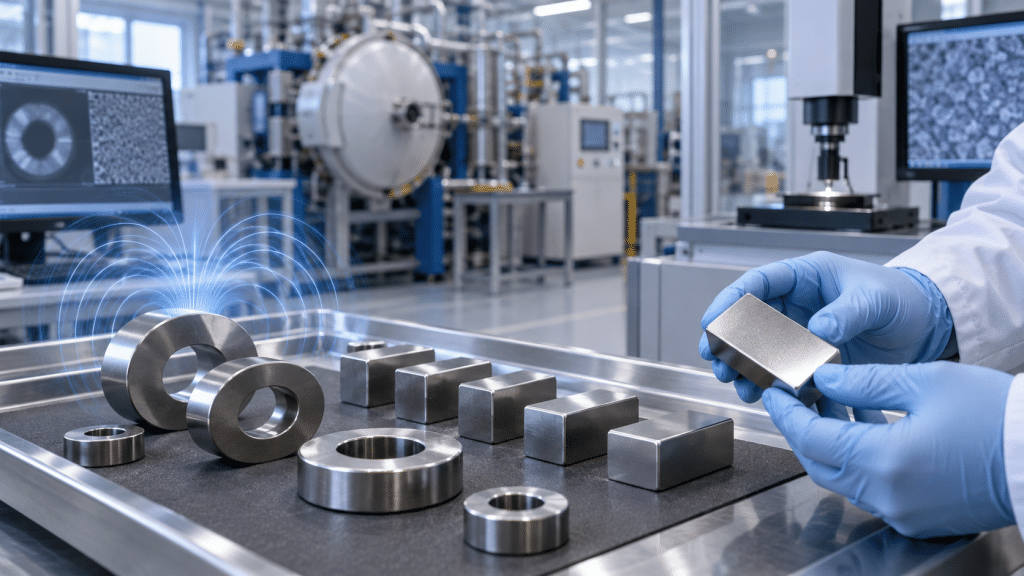
A pilot line jointly operated by Orano and France’s CEA in Grenoble has reported successful production of high-performance N45UH neodymium-iron-boron permanent magnets. The partners describe the result as evidence that the line can control the integrated manufacturing process, from material preparation through finished magnet production.
What the pilot line has demonstrated
According to the announcement, the line produced N45UH magnets with a stated remanence of 1.34 T and coercivity of 1,915 kA/m at 20°C. N45UH is a high-coercivity NdFeB grade intended for applications where strong magnetic output and resistance to demagnetization at elevated temperatures are both important.
Potential applications include traction motors, generators, actuators, robotics, industrial equipment, and magnetic sensors. The achievement is especially relevant because Europe is working to rebuild technical capability across the rare-earth value chain rather than depending only on imported finished magnets.
Why this matters to industrial buyers
For procurement and engineering teams, a successful pilot result is an encouraging supply-chain signal, but it is not the same as established high-volume commercial supply. Buyers evaluating a new NdFeB source still need evidence covering production capacity, lot-to-lot consistency, dimensions and tolerances, coating performance, magnetic orientation, traceability, and application-specific qualification.
The announcement also says the team can use the platform to develop other magnet grades. That could eventually support a broader range of motor, energy, automation, and defense requirements. However, no commercial output volume, delivery schedule, or customer qualification status was disclosed in the release.
Recycling is the next technical step
Orano and the CEA said they will continue optimizing the process and work toward adding secondary raw materials recovered through recycling. This matters because a circular magnet supply chain requires more than collecting end-of-life products. Recovered material must also meet tight chemistry, cleanliness, and process-control requirements before it can be used in demanding sintered NdFeB grades.
The pilot line therefore represents two separate milestones to watch: first, whether the manufacturing process can move from pilot operation to stable industrial capacity; and second, whether recycled feedstock can be introduced without compromising the magnetic, thermal, and mechanical properties required by customers.
What buyers should monitor next
- Demonstrated annual capacity and production ramp-up timing
- Customer qualification and sample availability
- Grade range beyond N45UH
- Coating, machining, magnetization, and inspection capabilities
- Share and traceability of recycled rare-earth feedstock
The result adds credible technical progress to Europe’s permanent-magnet strategy. Its commercial impact will depend on successful scale-up, consistent quality, and qualification by downstream users.
Source: Orano and the CEA Validate High-Performance Magnet Production on Their Pilot Line