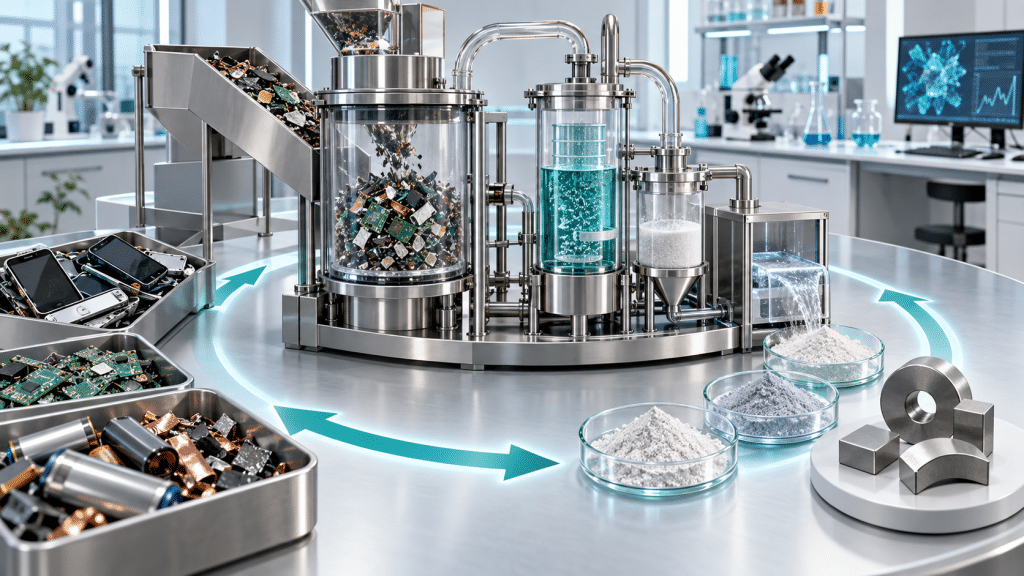
Summary: A new industrial R&D center in Greater Noida will develop recovery, recycling, refining, and automation technologies for critical materials, including rare earth elements from secondary resources. The announcement expands technical capacity, but it does not yet provide a rare-earth-specific production rate, recovery figure, or qualified magnet-material output.
R&D center targets complex secondary resources
Attero has operationalized a research and development center in Greater Noida, India, to support process development, automation design, and technology upgrades for critical-material recovery. The announced research scope includes end-of-life batteries, electronic components, industrial materials, and other complex secondary feedstocks.
The facility’s programs are expected to cover material-recovery processes and equipment development. Examples listed in the announcement include robotics-based battery cutting, battery-discharge systems, energy-efficient roasting equipment, filtration and drying systems, automated material handling, and ventilation and exhaust controls.
Rare earth elements are among more than 20 critical minerals that the company says it can recover across its broader platform. The new center is intended to move ideas from laboratory development toward potential industrial deployment across recycling, refining, and midstream operations.
Government recognition supports the research framework
The center has been recognized by India’s Department of Scientific and Industrial Research as an in-house industrial R&D facility through March 2029. That status may support access to applicable government facilitation for eligible research equipment and consumables, subject to the relevant rules and approval process.
The recognition confirms the facility’s place within an industrial research framework. It does not certify the commercial performance of any specific rare earth recovery process or product.
What magnet manufacturers should look for next
Recycling electronics and other secondary materials could diversify future sources of magnet-related rare earths. For NdFeB and SmCo supply chains, however, the value of recovered material depends on composition, separation, purity, consistency, and the ability to qualify the output for metal, alloy, and magnet production.
The public announcement does not identify a rare-earth-specific feedstock stream, individual element recoveries, production capacity, impurity profile, or customer qualification program. Procurement teams should therefore monitor future disclosures for:
- Feedstock definition: which electronic or magnetic waste streams are being processed and how their composition is controlled.
- Element-level recovery: results for neodymium, praseodymium, dysprosium, terbium, samarium, and other relevant elements.
- Product form and purity: whether the output is a mixed concentrate, separated oxide, metal, alloy, or qualified magnet material.
- Scale and repeatability: verified mass balance, throughput, environmental controls, and consistent performance outside the laboratory.
The center is a capacity-building signal for circular critical-material supply chains. Its contribution to magnet manufacturing will become clearer only when process-specific technical and commercial data are available.
Source: pv magazine India — Attero operationalises Greater Noida R&D Centre to advance critical mineral recovery technologies (published September 22, 2026, 09:27 UTC).