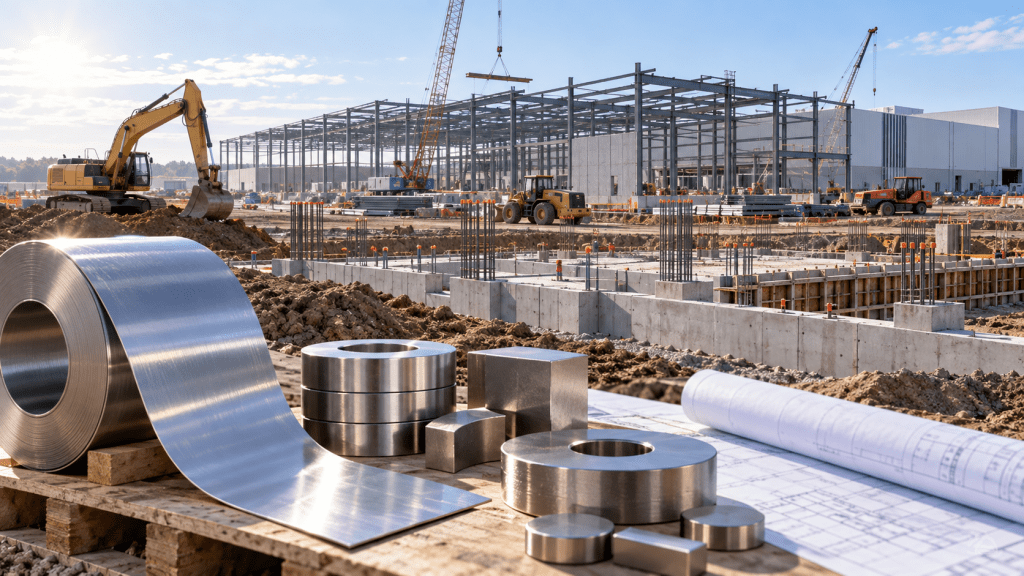
Summary: USA Rare Earth has broken ground on a South Carolina facility targeting 6,400 metric tons per year of sintered NdFeB magnets and 5,000 metric tons per year of strip-cast metal and alloy. Commissioning is targeted for 2028, so the announcement expands the future supply map but does not represent available production today.
A new U.S. magnet project has moved into construction
USA Rare Earth announced on September 9 that construction had begun at its planned rare-earth metal and magnet manufacturing site in Blacksburg, South Carolina. The company described an approximately $1.2 billion investment on a 124-acre site, with an approximately 800,000-square-foot facility and roughly 490 expected manufacturing jobs.
The stated production target is 6,400 metric tons per year of sintered neodymium-iron-boron permanent magnets and 5,000 metric tons per year of strip-cast metal and alloy. Commissioning is targeted to begin in 2028. Those numbers are planned capacity and timing, subject to construction, equipment, feedstock, qualification and other execution risks.
The project links alloy and magnet production
The proposed combination of strip-cast material, alloy and finished magnets is important because supply security depends on more than the final pressing and sintering step. Feedstock chemistry, alloy preparation, powder processing, heat treatment, machining, coating, magnetization and inspection must all deliver repeatable performance.
USA Rare Earth said the South Carolina operation will complement its existing Stillwater, Oklahoma magnet manufacturing operation. Together with a planned Stillwater expansion, the company expects the two sites to provide 10,000 metric tons per year of U.S. NdFeB magnet capacity. Again, the combined figure is an expectation rather than current qualified output.
What buyers should verify before treating capacity as supply
For automotive, aerospace, industrial motor or electronics programs, a factory announcement is the start of a sourcing conversation, not the end of qualification. Buyers should verify the grades to be offered, heavy-rare-earth strategy, coating capabilities, size and tolerance range, statistical process controls, application approvals, traceability and expected sample timeline.
Procurement teams should also ask how much of the stated capacity is covered by customer programs, which production steps will be performed on site, and what feedstock and alloy sources are planned. These questions help distinguish nameplate capacity from the volume that can be delivered to a specific drawing and quality standard.
Source: USA Rare Earth, September 9, 2026.