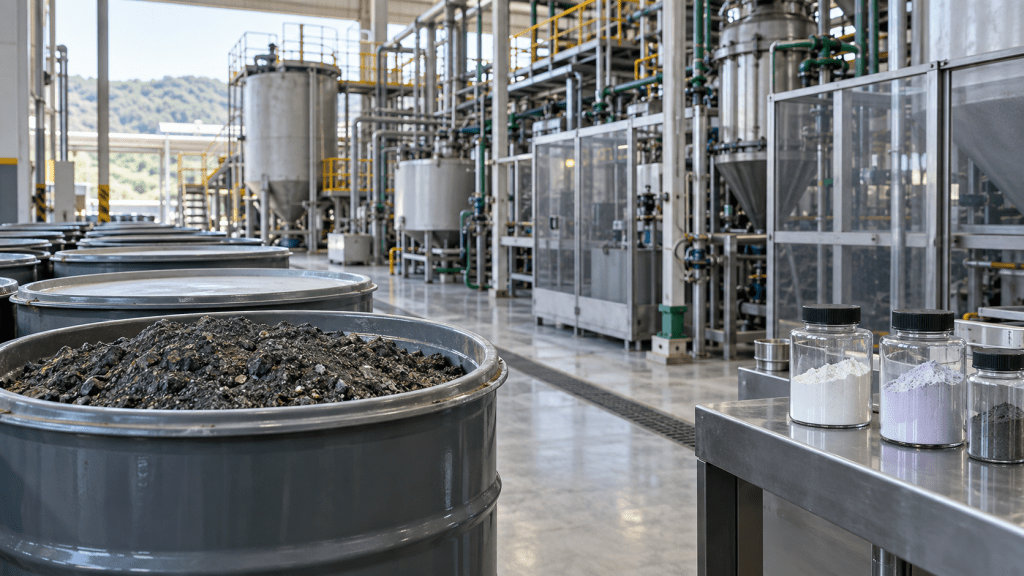
A rare-earth pilot program in Bahia, Brazil, has moved from laboratory development into continuous processing work. A September 8 company update reported that the first-stage circuit at Camaçari has been commissioned and has produced its first rare-earth mineral concentrate. The facility is designed to generate process data for engineering, equipment selection and cost estimates rather than to represent commercial-scale production.
The next stage is planned to add hydrometallurgical extraction and separation capability. According to the announcement, the program is intended to produce neodymium-praseodymium oxide, a heavy rare-earth concentrate and uranium yellowcake. Equipment delivery is expected in the fourth quarter of 2026, with Stage II commissioning targeted for the second quarter of 2027. These dates remain project plans and should not be treated as guaranteed supply milestones.
For permanent-magnet buyers, the most relevant development is the effort to create material suitable for technical testing and potential customer qualification. NdPr oxide is a key upstream input for many NdFeB magnets, while dysprosium and terbium can support selected high-temperature and high-coercivity grades. However, a pilot concentrate must still pass separation, purity, metal and alloy conversion, magnet manufacturing and end-use qualification steps.
Procurement teams should therefore watch recovery consistency, impurity control, product specifications, sample availability and the transition from pilot output to financed commercial capacity. The update is a useful supply-chain milestone, but it does not yet establish volume, delivery timing or qualification for any specific magnet application.
Source: Brazilian Rare Earths ASX announcement, September 8, 2026